World Workplace Europe 2026: big AI promises, a data bottleneck
In The Hague, AI was everywhere. But data is still what holds facility management back, and its future rests first on human skills.
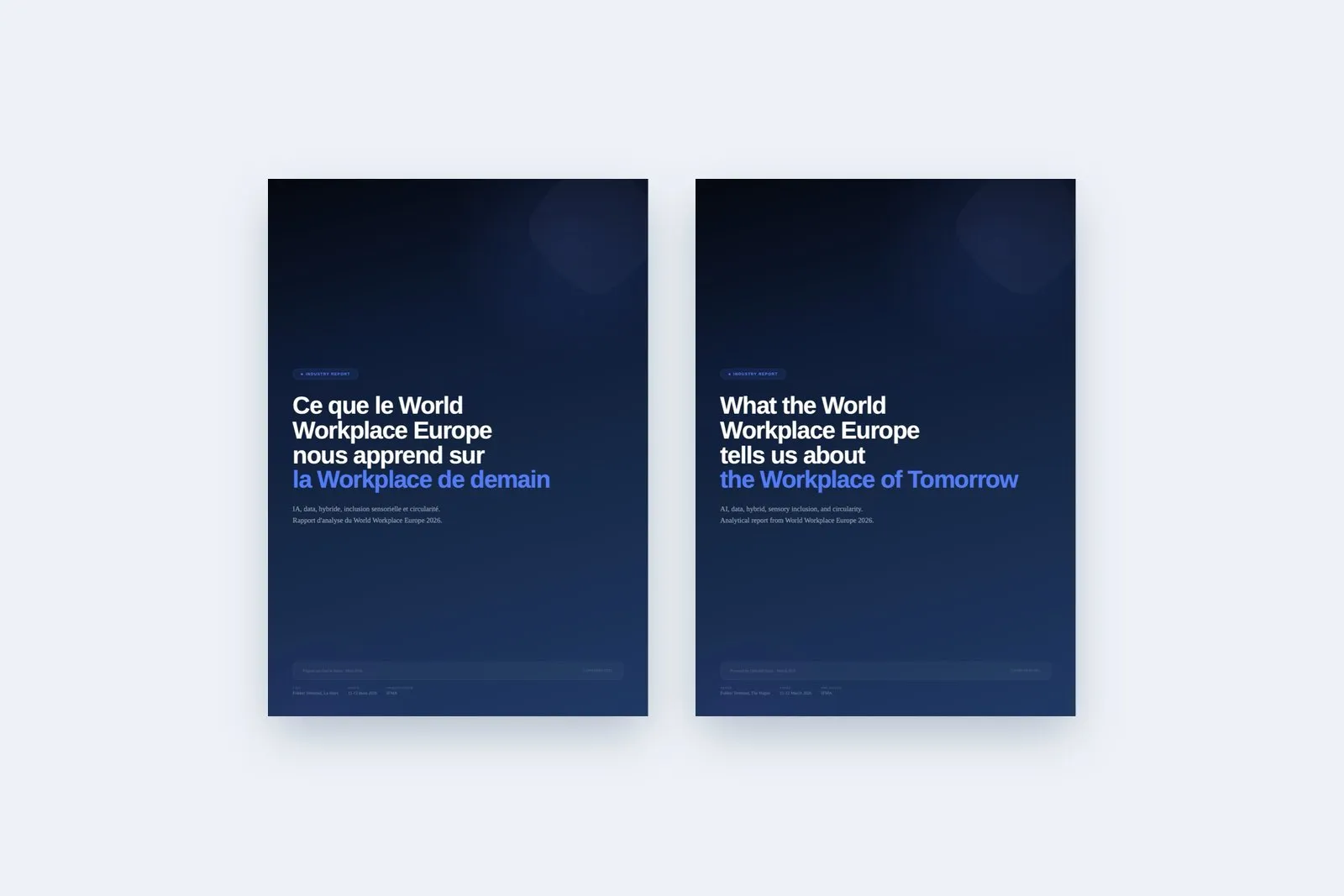
World Workplace Europe 2026, the annual gathering of European facility management organised by IFMA, took place on 11 and 12 March 2026 at the Fokker Terminal in The Hague, in the Netherlands. Osol and Sedus produced a report on it that cross-analyses 19 talks. Its main conclusion: AI featured in almost every session, but data is still what holds the profession back, and the future of FM depends less on its tools than on its ability to turn that data into decisions.
AI promises a lot, but 95% of pilots never scale
Remy Gieling, co-founder of AI.nl and The Automation Group, opened the event with some dizzying examples. IKEA automates 47% of its customer service questions and has retrained 8,500 agents as in-store design specialists. The Dutch group Ahold already runs 40,000 AI agents. He also warned that the cost of AI services will rise at least tenfold within three years.
Felix Faassen, who leads the AI Lab at Ifmec Consultancy, offered the counterpoint. Citing MIT, he pointed out that 95% of AI pilots fail to scale. The EY Work Reimagined Survey, covering 17,000 respondents, points the same way: only 28% of companies turn their AI investment into real value.
His most telling example concerns radiologists. Ten years ago, their disappearance was being predicted. Today, open positions are at a record high and salaries have risen by 48%, because reading scans is only 30% of their work. From this, Felix Faassen draws simple advice for FM teams:
Don't start with the efficiency question. Start with what is valuable and meaningful.
The real bottleneck isn't AI, it's data
Matt Tucker, Chief Research and Insights Officer at IFMA, summed it up in the closing keynote: almost no one can access all their FM data from a single system. Most use five or more, and many professionals end up keeping their own spreadsheets. At a round table led by Honeywell, a Finnish forestry group described 78 suppliers on a single production site, with no shared platform.
The most concrete case came from FMHaaglanden, the Dutch government's FM organisation. Bas Wolse described its move from 2D drawings to a 3D model covering 600,000 m². Before that, seven people worked full time in AutoCAD just to keep the plans up to date. Another point of consensus from the round tables: when you outsource a service, you must keep ownership of your data, and write it into the contract.
Hybrid work is settled by conversation, not by policy
Dr Yoy Bergs, an organisational psychologist at Breda University, recalled the idea of the psychological contract: the unspoken expectations between employer and employee. Changing the rules abruptly breaks that contract. For Tim Allen (HCG), we fall back on the simple question of how many days because we are not ready for the difficult conversation.
Bart Lugtenberg, HR lead at NXP Semiconductors (35,000 employees, 40 countries), stressed alignment at the top. When two leaders out of ten don't believe in the hybrid policy, everything below them stays dark, like the lower branches of a Christmas tree. He showed it live: he asked the room to touch their chin while touching his own head. Everyone copied his gesture. His conclusion:
People don't do as leaders say. People do as leaders do.
At PwC in the Netherlands, which hires 800 to 900 people a year, Maurice Verwer mandates no office days: he tries to make the office attractive instead. Thijs Bullman (TenneT), who welcomes 100 new starters a month, noted that making a friend at the office is one of the strongest reasons people stay. From the same survey, Jessica Schmidt (EY) draws a threshold of 40 hours of AI training: below it, employees leave for pay; above it, they leave to develop. We had already covered the mistakes that make a hybrid model fail.
Sound is still the main source of frustration at the office
Rainer Machner (Ecophon Saint-Gobain) quoted Tim Oldman, founder of the Leesman Index: after 15 years of measurement, dissatisfaction with noise has stalled at around 30%. Technical solutions alone resolve only 30 to 35% of complaints. They need to be combined with how zones are organised and with house rules written together with the teams.
Sarah Tancell, founder of Neuro-D., pointed out that one person in five is neurodivergent, up from one in seven three years ago. For them, sound is the biggest challenge at work. Noise-cancelling headphones are not the answer, and neither is silence. Fran Board (Moodsonic) argues instead for sensory zoning: different soundscapes for different activities, adjusted in real time to occupancy. In Sarah Tancell's words:
Sound matters. It's about creating environments that others don't need to adapt to.
Sustainability is decided in the buildings that already exist
Redney Janssen, Business Development Director ESG at Planon, set out the figures. In a typical UK commercial building, operational carbon accounts for only 24% of lifecycle emissions. The remaining 76% comes from materials, construction, maintenance and end of life. Since 90% of today's buildings will still be standing in 2050, the challenge lies in the existing stock: a well-maintained asset is 30 to 60% more sustainable.
Hélène Carpentier (Circular Workplaces) put a figure on the cost of doing nothing for an office of 2,000 people: £1.6 million over five years, of which one million can be controlled through circular initiatives. The main lever is procurement, which has to think about the whole lifecycle.
FM becomes strategic, provided it can tell a story
Emir Sarialan (CBRE / University of Reading) described three stages: traditional FM keeps the building running, integrated FM drives efficiency, strategic FM carries experience and culture. At Sanofi, Ömer Döne (Global Head of Sustainable Workplace) now recruits people with a hotel background for FM roles. Eve Wilkinson-Bell (HERE Technologies) warned that there is no point collecting data if you do nothing with it.
In the closing keynote, Matt Tucker presented research based on 37 interviews with FM data experts. The conversations always came back to human qualities: curiosity, storytelling, pattern recognition, confidence with data, problem solving and cross-functional thinking. It is not about taking an advanced statistics course, he explained, but about learning to turn data into an argument for the finance director or HR.
What we take away
Data integration often starts with the friction occupants experience every day. In hybrid spaces, power is part of it: an outlet nowhere to be found, a flat battery in the middle of a meeting. And when spaces change as uses evolve, electricity remains the last fixed infrastructure in the office.
The report covers the 19 talks, the event's weak signals and ten practical actions sorted by role. Download the full report
Frequently asked questions
When and where did World Workplace Europe 2026 take place?
On 11 and 12 March 2026, at the Fokker Terminal in The Hague, in the Netherlands. It is organised by IFMA.
What is the main lesson from the event?
AI is everywhere, but data is still the real bottleneck: scattered across several systems and rarely accessible from a single tool.
Why do so many AI projects fail in facility management?
According to an MIT study cited by Felix Faassen, 95% of AI pilots never scale. Without reliable, accessible data, no AI strategy holds up.
Who wrote this report?
Maxime Cousin, CEO of Osol, and Sinem Beaujean, Global Engagement Strategist at Sedus, with a contribution from Calle Sagbom, an independent workplace strategist.