FM Days 2026: the office isn't dying, the old rulebook is
At FM Days 2026, the opening keynote was clear: the generic office is fading, and the one that earns attendance and learns from real use is taking over.
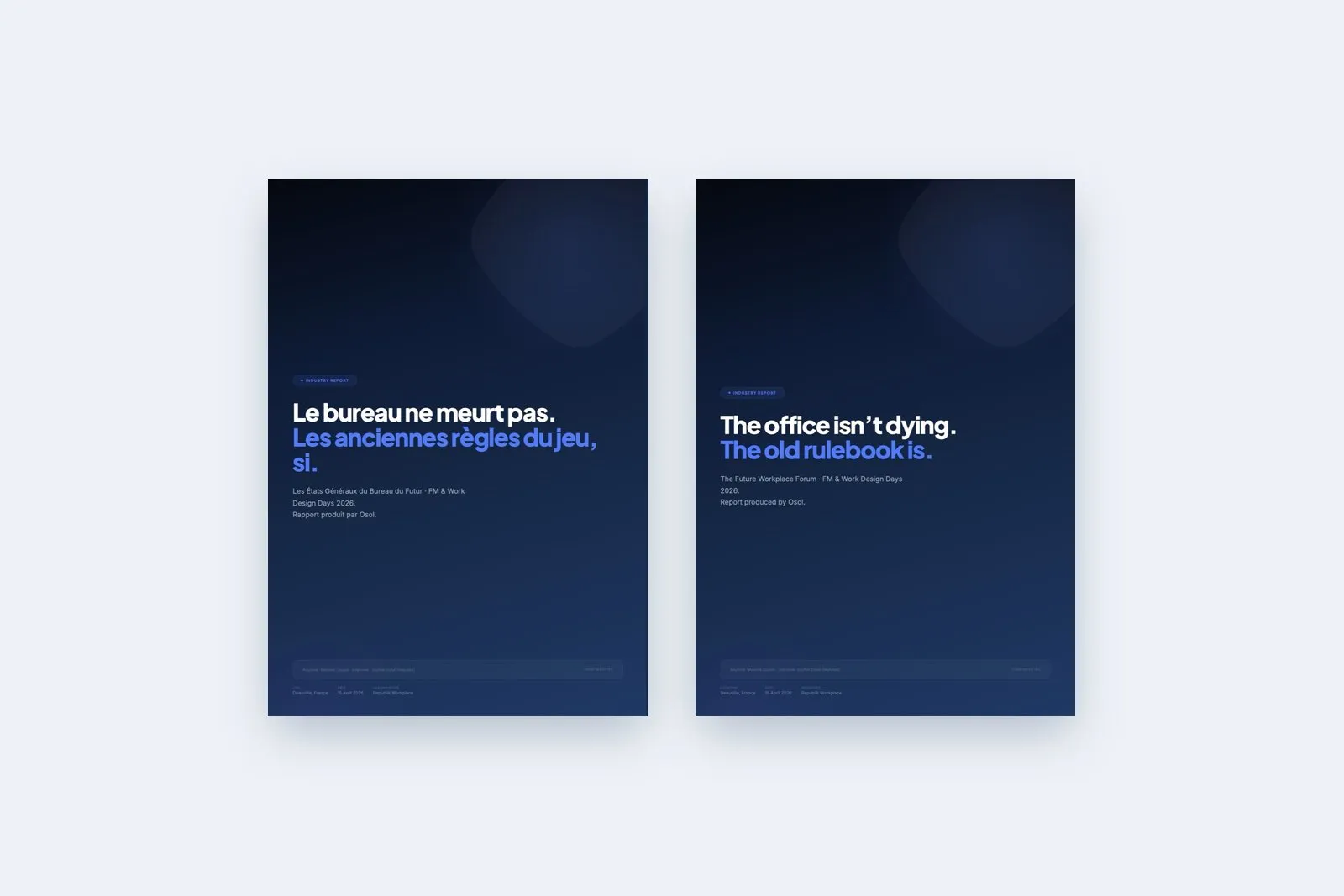
FM & Work Design Days 2026, organised by Republik Workplace, took place in Deauville on 15 April 2026. The opening keynote brought together Olivier Saguez, founder of the design agency Saguez & Partners, and Maxime Cousin, CEO and co-founder of Osol, interviewed by Sophie Distel, journalist and director of Republik Workplace. Its conclusion fits in one sentence: the office isn't dying; what is disappearing is the generic office, copied from site to site with a 200-page playbook, in favour of an office that earns the presence of its occupants and learns from how it is really used.
Our report focuses mainly on Maxime Cousin's talk, informed by visits to some fifteen countries. Here are the essentials.
The office has to earn attendance
The keynote's central idea fits in two words: “earn attendance”. The office is no longer the default: competing with home, the café and coworking, it has to prove its worth every day. JPMorgan has taken this seriously. Its new global headquarters at 270 Park Avenue, designed by Foster with interiors by Gensler, opened in New York in October 2025, represents $4 billion, 60 floors and 10,000 employees.
The first way to earn attendance is to remove the small frictions. Biometric entry at JPMorgan. Facial recognition and 100 robots delivering coffee and post at Naver, in Seongnam, South Korea. A hospitality service inspired by grand hotels at Sanofi.
The office is also refocusing on what remote work cannot do: learning by osmosis, when a junior watches a senior negotiate; collaboration with high emotional stakes; building culture and social ties. Servier puts labs inside its offices; CMA-CGM, in Marseille, placed its own facing the port.
Why does the hierarchy of needs come before inspiration?
The keynote set out a hierarchy of office needs in five levels, cumulative like Maslow's. At the base is the vital: connectivity, ergonomics, air, acoustics, light, temperature, power. Then control over your space, wellbeing, connection, and finally meaning and culture.
The top isn't an extra: it is the office's reason for being. But according to the keynote, 90% of companies try to paint the top before they have poured the foundations. They invest in rooftops and brand murals while the acoustics fail, the rooms are always booked and people turn up to meetings with a laptop on 12%.
The intentional office replaces the generic one
Every space now has to be justified by a use, not a standard. The clearest example is Sage: 13 offices delivered in 18 months across 5 cities and 3 continents, all different, with a 10-page master document. Most large companies work with manuals of 100 to 200 pages. At Sage, the brand team led the project from day one.
A new role is emerging: the “guardian of the brief”. Their job is to protect the original commitments against value engineering, the cost trade-offs that turn an oak floor into vinyl between the brief and the handover.
Experience becomes the yardstick. Sanofi now hires former hotel managers to run its sites, and the workplace is moving towards HR rather than finance. The argument is simple: a payroll costs ten times more than rent.
The desk is back, as transition infrastructure
Between 2020 and 2023, many companies swapped desks for sofas. They went too far: even when you come in to collaborate, you need an hour of quiet between two meetings or somewhere to take a call.
So the desk is back, but as a comfortable stop between two interactions, more residential than corporate. The logic shifts from workstations to activities. The report offers a benchmark: if less than 30% of your floor space supports focused individual work, you have probably overcorrected since 2020. These transition zones have to be ready in seconds, which raises the question of power in spaces without assigned desks.
No AI strategy without a data strategy
According to the keynote, 70% of large companies' AI investments produce no value at all. 95% of AI proofs of concept fail to scale, according to an MIT study. Only 28% of companies turn their AI investment into real value, according to an EY study with 17,000 respondents.
The cause is the same everywhere: a large company runs an average of 70 applications and 10 core systems, with no integration between them. When the data is clean, the gains are real. ServiceNow, presented at the Workspace Design Show in London in February 2026, saved 72,000 hours in a year by automating the triage of workplace tickets, the equivalent of 40 full-time people for 26,000 employees.
Acoustics, the office's blind spot for fifteen years
Today, 1 person in 5 is neurodivergent, up from 1 in 7 three years ago, because diagnosis is improving. For them, the number one challenge at the office is sound. And according to the Leesman Index, acoustic dissatisfaction has been stuck at 30% for 15 years, with no progress at all.
Handing out noise-cancelling headphones isn't a solution, it is an abdication: it puts an environmental problem on each individual. Absolute silence isn't the answer either. The approach put forward is sensory zoning, with benchmarks of 50 to 55 dB for focus spaces and 60 to 65 dB for collaborative spaces, and acoustics designed in from the brief.
Why data kills standardisation
You might expect a single global office model to win out in the end. The opposite is happening. NXP has 35,000 employees in 40 countries and cannot run a single hybrid policy: in France, people come in when the boss asks; in the Netherlands, they negotiate. Usage data points the same way. Peak occupancy might fall on Tuesday morning in Lille and not in Nice, and phone booths might be full in Paris and empty in Bordeaux. The more you measure, the harder it is to justify copying.
Maxime Cousin closed with a line that sums up the report:
The turnkey office is dead. The office that learns from itself is being born.
What we take from it. Power sits on the first level of the hierarchy, alongside air and light. A transition desk or a meeting room doesn't do its job if the laptop arrives on 12%. This belongs to the office's foundations, not its options.
The report also covers the differences between regions of the world and practical advice for each role. Download the full report
Frequently asked questions
What are FM & Work Design Days?
An annual event organised by Republik Workplace in Deauville, bringing together decision-makers from facility management, corporate real estate and workplace design. The 2026 edition took place on 15 April.
What does “earn attendance” mean?
That the office is no longer the default. It has to earn people's presence by removing frictions and offering what remote work cannot.
Why do so many workplace AI projects fail?
For lack of a data strategy. 70% of AI investments produce no value, because occupancy, maintenance and services systems don't talk to each other.
What does the report recommend on acoustics?
Replace noise-cancelling headphones with sensory zoning: zones with different sound profiles, gradual transitions between them, and acoustics built into the design rather than added as a fix.