Worktech Zurich 2026: the technology is ready, organisations are not
At Worktech Zurich 2026 the verdict was clear: AI and buildings are ready, but adoption is held back by people, managers and habits.
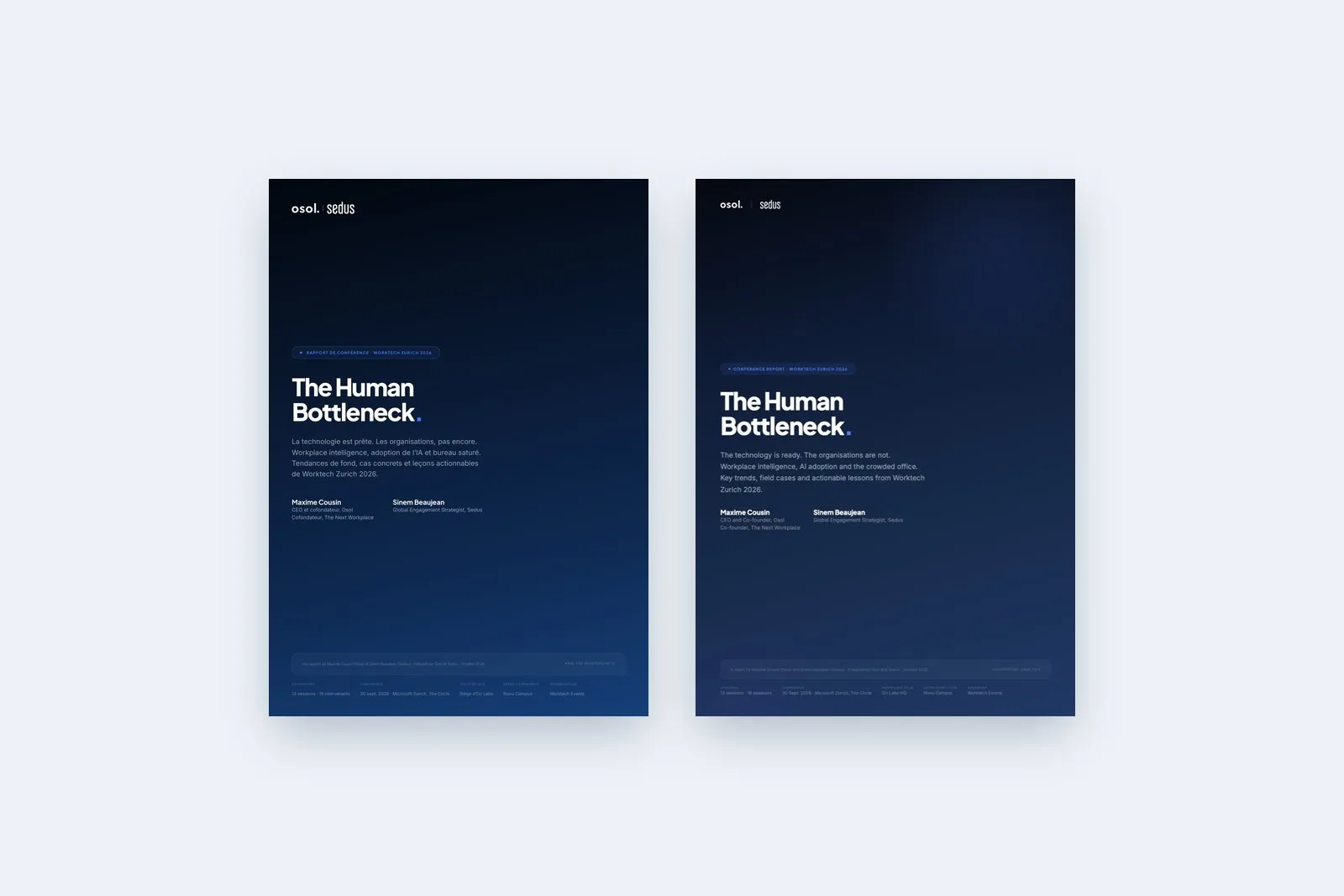
Worktech Zurich 2026 took place on 30 September 2026 at Microsoft Zurich, in The Circle, next to Zurich Airport. Microsoft hosted the day. Organised by Worktech Events, it brought together around a hundred workplace, real estate, IT and HR professionals and 19 speakers. Its conclusion fits in one sentence: the technology is ready, organisations are not yet, and the real bottleneck is human. That is the title of the report we co-authored with Sedus, The Human Bottleneck.
AI access does not create adoption
The morning opened with three AI sessions back to back: Microsoft, BCG and SIX Group, which runs the Swiss stock exchange. All three told the same story. Jan Medřický (AI Business Solutions Sales Lead, Microsoft) named leadership AI literacy as one of the biggest blockers, and the first-line manager, the "M1", as the real lever.
Mark Jenkins (Head Digital Workspace, SIX Group) summed it up in one line: "Tech is pretty easy." SIX went from 20 Copilot licences in July 2024 to around 4,500 internal users. About 20% of users generate about 40% of prompts. Unused licences are reallocated under a simple rule: "You don't use it, you lose it."
Orsolya Kovacs-Ondrejkovic (Partner and Associate Director, People Strategy and HR, BCG) put it bluntly: giving everyone a copilot "is going to save enough time to maybe have a coffee". The value comes from redesigning the work itself.
Headcount is no longer enough to plan space
On stage, Microsoft said its revenue had grown 57% in three years, with headcount flat since 2022. A vendor claim, but the direction matters: growth can decouple from headcount. BCG added a caveat: 30% of time saved is not 30% fewer people.
Véronique Neiss (Head of Real Estate and Facilities, Bank for International Settlements) is designing a new tower opposite Basel's main station, the BIS's first project on this scale in more than 60 years. She asked the question out loud.
What is the impact of AI agents in terms of capacity? We don't know yet. Our figure crunching is still quite standard. But it's a burning question, and we need to find answers before we start the execution of the work.
Hence the report's advice: plan on scenarios rather than headcount projections, with shorter commitments and convertible floors.
The office is back, and it is full
After years of empty offices, Zurich talked about full ones. Roger Meier (founder and CEO of ROOMZ) presented CBRE's 2026 study: 53% average utilisation, 80% at peak and 111% of desks allocated. 68% of employees say they come in mainly to collaborate.
At On Labs, the Zurich headquarters of the running brand On, headcount grew from around 200 to more than 1,300 people in five years. Its Workplace Experience team is now tackling ghost bookings and desk hoarding. At Lombard Odier's new Geneva headquarters, two collaborative spaces of about 1,000 m² each were full within two days, once middle managers accepted that their teams also work away from their desks.
Polled on the hardest workplace trade-off, the room chose collaboration versus focus: people come in to see each other, then look for a quiet corner.
Two questions beat fifty
The data panel, chaired by Philip Tidd (Managing Director and Principal, Gensler), was mostly about how little data you need. Peter Baumann (Global Head of Strategy and Planning, Global Real Estate and Facilities, SAP) now steers SAP's portfolio on two questions: how people feel in the space, and whether they think it makes them more productive. For Tidd, the industry is "a little too obsessed about data".
Change also has a dip: satisfaction drops after a move, then recovers. Alex Wilkins (Global Lead, Real Estate Transactions, Roche) records an average 12% gain in user perception after every well-managed project. The industrial group Bühler asks users not to change the space for the first three to six months. The shared rule: be patient, and quantify feedback.
Build for change, not for eternity
Architect and designer Stephan Hürlemann told of a brief for PwC's Experience Center that went from 45 desks to about 120 in a few weeks, back in 2015. His answer: build as little as possible, with furniture the team moves itself and micro-architecture that does without the ceiling. Elements you can move, reuse or resell stay assets instead of becoming waste.
Peter Baumann (SAP) added the financial angle: leasing this kind of fit-out would substantially improve his cash flow. "Leasing or renting objects. This is the future," Hürlemann replied. Flexibility is financial too, as we saw with refurbished furniture.
A space is felt before it is used
Offices have multiplied "modes": booths, quiet rooms, lounges. Malou von Gleichenstein (co-founder of SOA Soundarchitecture) named the limit: "People don't get in the mood just because there is a couch." Her tool is sound. At a German audit firm, the soundscapes her team designed drew only 3% disapproval, whereas something as ordinary as the office coffee splits opinion fifty-fifty.
Sinem Beaujean (Global Engagement Strategist, Sedus) widened the question to inclusion: everyone experiences the same room differently. The answer is not one perfect setting, but a choice between several atmospheres.
People first, technology in their service
Bühler Group invested more than CHF 120 million over ten years in its historic site in Uzwil. First project: the staff restaurant, the one place everybody uses. Elvis Pidic (Head Group Architecture and Real Estate Management, Bühler Group) explained why.
I can do focused work in Starbucks, on the airplane, wherever. But the reason to go to the office is to meet people. The reason for coming back was not the sit-stand desk. The reason for coming back was the collaboration with colleagues.
Lombard Odier followed the same order: first spaces that bring people together, then one of the most advanced smart buildings presented on the day, with 250,000 data points. The room leaned the same way: 83% of delegates named human value among what will define the workplace over the next decade, and only 30% financial value.
What we take away. In a full office, every space has to become somewhere you can work: the meeting room between bookings, the café after lunch, the lounge. What decides it is often very practical: a free socket where you want to sit. And if the building has to change as fast as the brief, power cannot remain the last fixed infrastructure in the office.
The report covers all 13 sessions, the On Labs tour and concrete actions by role. Download the full report
Frequently asked questions
When and where did Worktech Zurich 2026 take place?
On 30 September 2026, at Microsoft Zurich, in The Circle, next to Zurich Airport. It was organised by Worktech Events.
What was the main message of Worktech Zurich 2026?
Technology is no longer the constraint. Adopting AI, like adopting new workspaces, comes down to people, managers and habits.
Who wrote The Human Bottleneck report?
Maxime Cousin, CEO and co-founder of Osol, and Sinem Beaujean, Global Engagement Strategist at Sedus.