Hybrid model: the 10 mistakes that make it fail, and how to avoid them
Hybrid models rarely fail because of remote work, but on alignment, false flexibility, managers and an unchanged office. BICG's 10 mistakes and fixes.
A hybrid model rarely fails because of remote work itself. It fails because the leadership is not aligned, flexibility comes down to fixed days, managers are not trained and the office stays the same. To avoid this, start from the company's strategy, analyse profiles and activities, let teams set their own agreements, then measure.
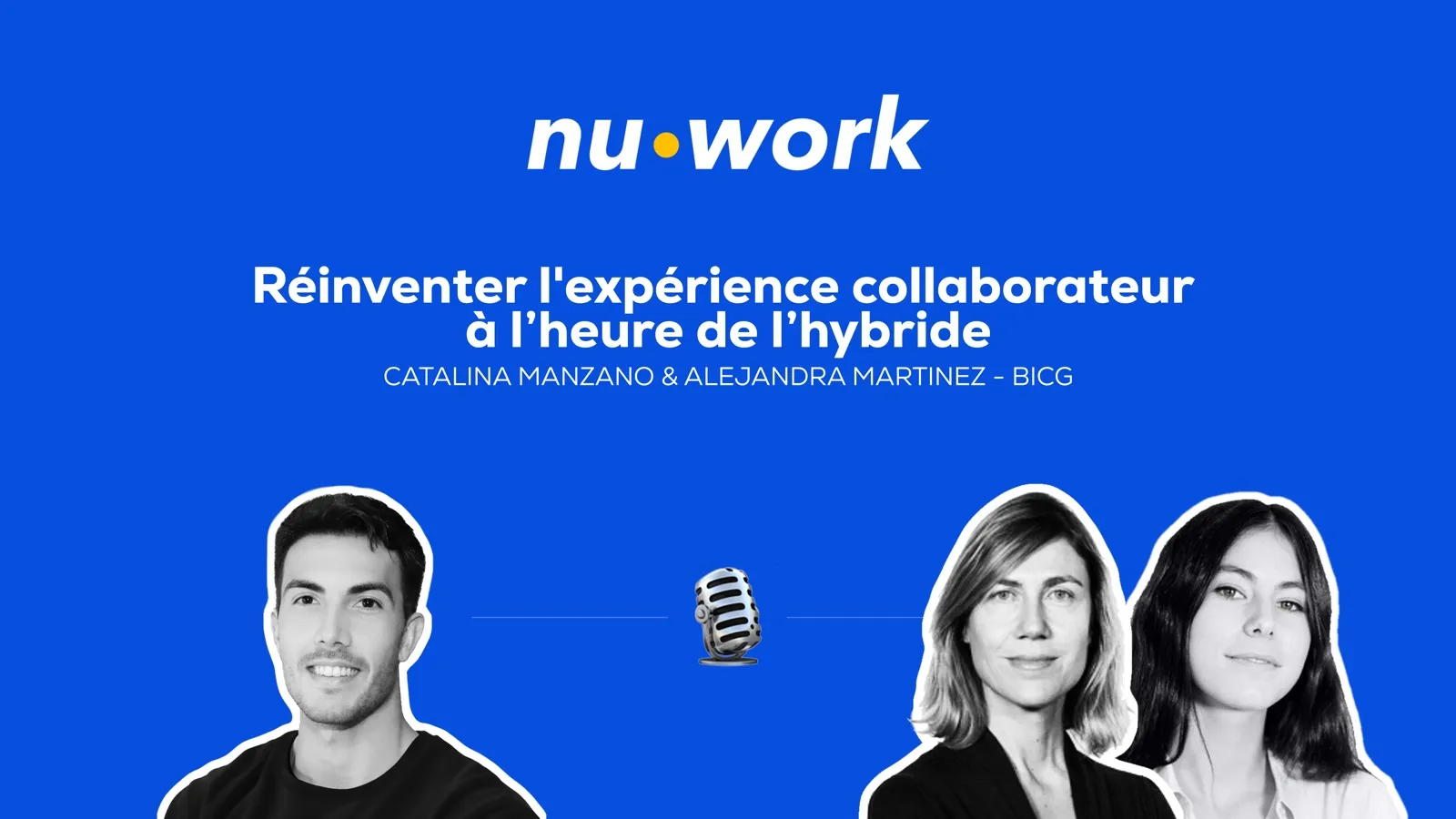
These ten mistakes come from a series of episodes of the NuWork podcast, produced in partnership with IDET, with Alejandra Martinez Boluda, Managing Director, and Catalina Manzano Laina, Project Manager, of BICG (Business Innovation Consulting Group). The firm grew out of a research institute, Fraunhofer IAO, dedicated to changing the way people work. With more than 20 years of experience and 400 projects, BICG has adapted its method to a constantly changing working environment.
Its conviction: treat the workplace as an organisational tool, and combine several disciplines (work organisation, culture, technology, space) to improve the employee experience. Its hybrid model rests on six pillars, including defining employee profiles, the number of days spent working remotely, the needs of each team and the infrastructure needed to work in different places.
The hybrid model is not a new idea
“We come from a research institute, and since 1997 we had already established this concept of flexibility along the axes of time and space. It is a concept that has existed ever since technology disconnected us from a single place.” Alejandra Martinez, BICG
With the Great Resignation in the United States, or quiet quitting, you might wonder whether workers' disengagement comes from too much change. BICG sees it the other way round: change is a decisive factor in how work is organised. When it is well managed, a transformation phase is followed by a stabilisation phase, which makes it possible to study the model and redirect the strategy. It is an excellent way to test how well a hybrid model performs.
“When you put a hybrid model in place, performance becomes extremely important.” Alejandra Martinez, BICG
Why hybrid is worth doing well
The benefits are real. Employees become masters of their own time: less commuting, more freedom in their hours. Given that 95% of employees say they are more motivated when they choose how they work, that is a strong argument. Productivity is measured by results rather than presence, which values employees and makes them more autonomous. Hybrid working, accelerated by Covid, has also consolidated the tools that digitise processes, to the point that some employees have closer ties with colleagues on the other side of the world than with their neighbours in the building.
For Maxime Cousin, it is also an asset for attracting talent. Companies are no longer competing with those in Paris, Madrid or Lyon, but with the whole European job market. Offering hybrid options has become a must. Provided you avoid the following mistakes.
Mistake 1: going hybrid out of inertia, not conviction
The hybrid model is not a passing fad. Putting it in place is complex, and it leaves little room for haphazard methods or half-hearted choices.
How to avoid it: start from the company's purpose and strategy. Why do we work? What are our values, missions and objectives? What does the company want to become, and how does it want to grow? For Alejandra Martinez, the business strategy must be linked to these decisions: if the company wants to evolve, it has to show how its teams need to adapt. Connecting each person to these reasons, in harmony with their personal life, strengthens their loyalty and shows them they have a place in the whole.
Mistake 2: letting leadership teams fall out of alignment
When senior management is not aligned, it can be fatal to the project. Companies often begin the transformation with a single goal: retaining talent. Yet it is the overall vision that decides success.
BICG saw this during a workshop with employees in Switzerland. One of them summed it up: “I come in to the site, but people no longer know how to collaborate and work respectfully with each other. They take Teams meetings all day long, and I can't concentrate. Why come back to the site when I work better at home?” By tracing the issue back, the firm found the problem: decision-makers in the different departments had not been aligned when designing the model.
How to avoid it: have the model designed jointly by human resources, work organisation, workplace and IT. That is the purpose of the Welcome Back programme launched by BICG: bring these disciplines together so that the return to the office is a positive experience, not the discovery that you work better at home. For Maxime Cousin, support has to happen at every level (executive leadership, management, employees): difficulties arise when decisions become stratified and lose their permeability.
Mistake 3: offering remote work without a strategy
Remote work must be introduced tactically, not as a way to cover the subject without going deeper into the fundamentals of how people work: management, organisation, planning.
How to avoid it: first redefine three things, before even thinking about office or remote work. The space: make it a place for socialising, a concentrate of the culture. The link between the company and its employees: good practices and clear rules, which reserve work for certain key moments. The relationship between managers and their teams: defined objectives, and a way of working rewritten for both in-person and remote work. It is this “how” that shapes the flex office strategy, whose stakes are specific: a dynamic working ecosystem, collaboration between teams, an end to silos and departmentalisation.
Mistake 4: falling into false flexibility
This is rigid flexibility. Employees should be able to choose remote work according to their activities: when and why to work remotely. A common mistake is to set fixed remote-work days, or to plan them months in advance, which deprives employees of all the benefits. With employees' growing power over the terms of their contracts, leaving flexibility open is becoming the wise choice.
A lack of agreement leaves teams disoriented. Only 28% of organisations that have introduced a hybrid model have also put agreements in place between functions, setting out when to come in and why. More than 70% of employees do not know how to organise themselves with their teams, or when to come in.
“Organising is not about rigidity. It is above all about synchronising teams so they can meet in person.” Catalina Manzano Laina, BICG
How to avoid it: distinguish between the hybrid model, a fixed framework for the organisation, and team agreements. There is a big difference between “coming in on Tuesdays is compulsory” and “what matters to us, and which day would best suit our tasks for getting together?”. A fixed day is not forbidden, but it must come from a shared agreement. At BICG, there is no fixed day set aside for remote work: each team synchronises first.
Mistake 5: producing simplistic solutions, or endless ones
A single rule for everyone ignores the variety of jobs. Conversely, one option per employee becomes unmanageable.
“You have to be careful not to have a system too based on exceptions. In the end, this model has to be managed. Of course we take the particularities of each job into account, but we must not end up with endless models.” Alejandra Martinez, BICG
How to avoid it: during the analysis, build profile typologies from three questions. Who is likely to work remotely? How do our teams work? What do they need? Organising activities by zone also makes room for each person's individuality, whether introvert, extrovert or ambivert. And production roles are not excluded: flexibility can apply to how working time is arranged, for example with a 4-day week.
Mistake 6: neglecting tools
BICG makes a point of giving professionals all the tools they need to work well remotely. Teams, Miro, Mural: collaboration and brainstorming apps must match each company's specific needs. Their purpose is simple: to let employees carry out their daily activities without friction. At BICG, Reyteams, a tool developed in-house, has made its mark: it shows who will be in the office and when, and makes it possible to plan in-person work sessions.
“We are realising the impact of technology. It is what bridges the gap between digital and physical, in-person and remote. The weight of IT departments has changed, because they are becoming the glue.” Maxime Cousin, Osol
How to avoid it: involve IT teams in the project from the start, and choose tools based on actual use.
Mistake 7: leaving workspaces unchanged
“Activities will be completely different: the office will become the gravity point, essential for collaborating better.” Alejandra Martinez, BICG
The task for organisations is to rethink space so that it fits this new reality. Space optimisation, space savings: what do we do with them? What value do these spaces add? To answer these questions, BICG stresses collaboration between the workplace team and the other disciplines.
How to avoid it: organise space by activity. Activity-based working means grouping activities with similar profiles and avoiding friction between incompatible neighbouring activities, with three zones: socialising, interaction and quiet. Organisational zoning then divides the spaces between open-access zones, team areas and team territories, and determines what will remain fixed in the building. Unassigned spaces encourage cross-functional work.
FDJ offers a telling example. Its headquarters, which adopted this method in 2017, is made up of one third socialising spaces and one third collaborative workspaces. The cafeterias, once scattered across the floors of the old building, have been brought together in a single meeting place where employees from every division cross paths.
Third places matter too. Coworking spaces are stimulating, but it is hard to concentrate in them: micro-architecture elements such as focus pods create privacy there. Hotels, for their part, are increasingly courting remote workers with dedicated offers. It is better to define in advance which third places will be used, to set rules of conduct and keep a sense of control on the employer's side.
Mistake 8: filling office days with meetings
For Catalina Manzano, people chain meetings without planning them, and end up “working remotely on site”, shut in a room all day. The problem lies in their number, but also in the fact that we are not used to organising meetings with few participants, a clear agenda and someone to lead them. A Microsoft study shows that the number of meetings has risen by 250%.
With remote work, the boundary between professional and personal life has blurred. For Alejandra Martinez, the difficulty of disconnecting is linked to mental well-being, which is becoming fundamental in tomorrow's working ecosystem. Technology lets us reach anyone in one click: that is its beauty, and it is also what stops us from switching off.
How to avoid it: short, prepared and facilitated meetings, and ground rules restored around disconnecting. Flex work also has its own rhythm: asynchronous work leaves room for reflection and learning.
Mistake 9: neglecting consultation
Changing the working model means changing the culture, and that is the great challenge: changing habits and behaviours. For Catalina Manzano, the most obvious risk is losing the sense of belonging and cohesion. When you work at home, your only link with the organisation becomes your laptop. A Microsoft study indicates that 43% of leaders see building relationships as the biggest challenge of hybrid working. Talent, especially in tech, is drawn to hybrid working and does not want to come on site, but it does not feel the culture.
How to avoid it: support people with rigorous change management and good communication, and above all involve employees in the process so they take ownership of it. Then create on-site moments that pass on the culture, its values and its habits: weekly team meetings, team-building days where everyone discovers what the others do.
Mistake 10: not training your managers continuously
Management is the leading cause of resignations. Yet it is not enough to put the blame on managers. In Europe, people often move up from expert to manager without being prepared for it. Managers face pressure from senior management on one side, and on the other they manage teams who are not in the same place. We start from a management culture based on presence and micromanagement.
How to avoid it: develop trust and empathy, and give managers the right tools and culture: soft skills, but also tools to plan, to run one-to-ones, daily check-ins and feedback sessions. At BICG, this is the Leadership Journey, a programme that gives managers the skills they need.
Managers become the first relays of the culture. During a learning expedition to a Nordic country, Maxime Cousin saw this at King, the maker of Candy Crush: employees came in when they wanted, and whether the team understood and lived the culture had almost become a performance indicator for the manager. If a single person carries engagement, it becomes hard to energise 5,000 people without huge teams or budgets. Entrusted to managers, the culture gains a far more effective lever: hyper-proximity.
How do you know if your hybrid model is working?
You measure it on the two levers from the start: time and space.
On time, you estimate the share of secondary administrative tasks and how long they take, a method tested by Fraunhofer IAO. “We have reduced time thieves by up to 85% in exchange for more added value. Unnecessary bureaucracy is negatively correlated with people's motivation,” explains BICG.
On space, reallocating floor areas relies on a study of employees' journeys, their travel times between zones and the nature of their movements in the building. “We have optimised up to 40% of the company's usable floor area in m²,” the firm says.
The hybrid model can have a striking impact on a company's revenue and performance. But like any model, it carries risks, which are more or less well controlled depending on the quality of the preliminary study. For BICG, the workplace must then address three aspects: privacy, control over one's environment and the personalisation of spaces.
An office organised by activity has an often overlooked consequence: employees change space several times a day, and their laptop goes with them. Power has to follow these movements. This is what we call power flexibility.
Frequently asked questions
What is the most common mistake in a hybrid model?
False flexibility: imposing the same remote-work days on everyone, or planning them months in advance. Team agreements deliver better results than a single rule.
Should you set fixed days in the office?
The company can set a general framework, but choosing the days works better at team level, based on the moments when getting together is genuinely useful.
Who should lead a hybrid working project?
Several departments together: human resources, work organisation, workplace and IT, with executive leadership aligned on the objectives.
How do you make employees want to come back to the office?
By giving them a reason to come: spaces designed for collaborating, socialising or concentrating, organised team moments, and fewer meetings that could be followed from home.
Does the hybrid model suit production roles?
Yes, in a different form. Flexibility can apply to how working time is arranged, for example a 4-day week, rather than to the place of work.