Worktech Rotterdam 2026: friction is the office's next challenge
At Worktech Rotterdam 2026, the question was no longer where we work but the friction that separates a team that shows up from one that performs.
Organised by Worktech Events, Worktech Rotterdam 2026 took place on 11 June 2026 at Haskoning, on the TU Delft campus. More than 100 professionals from workplace, real estate, IT, design and HR attended 13 sessions. The day's conclusion: the question of where people work is settled, and the real issue now is friction, the dozens of small failures that separate a team that shows up from one that performs.
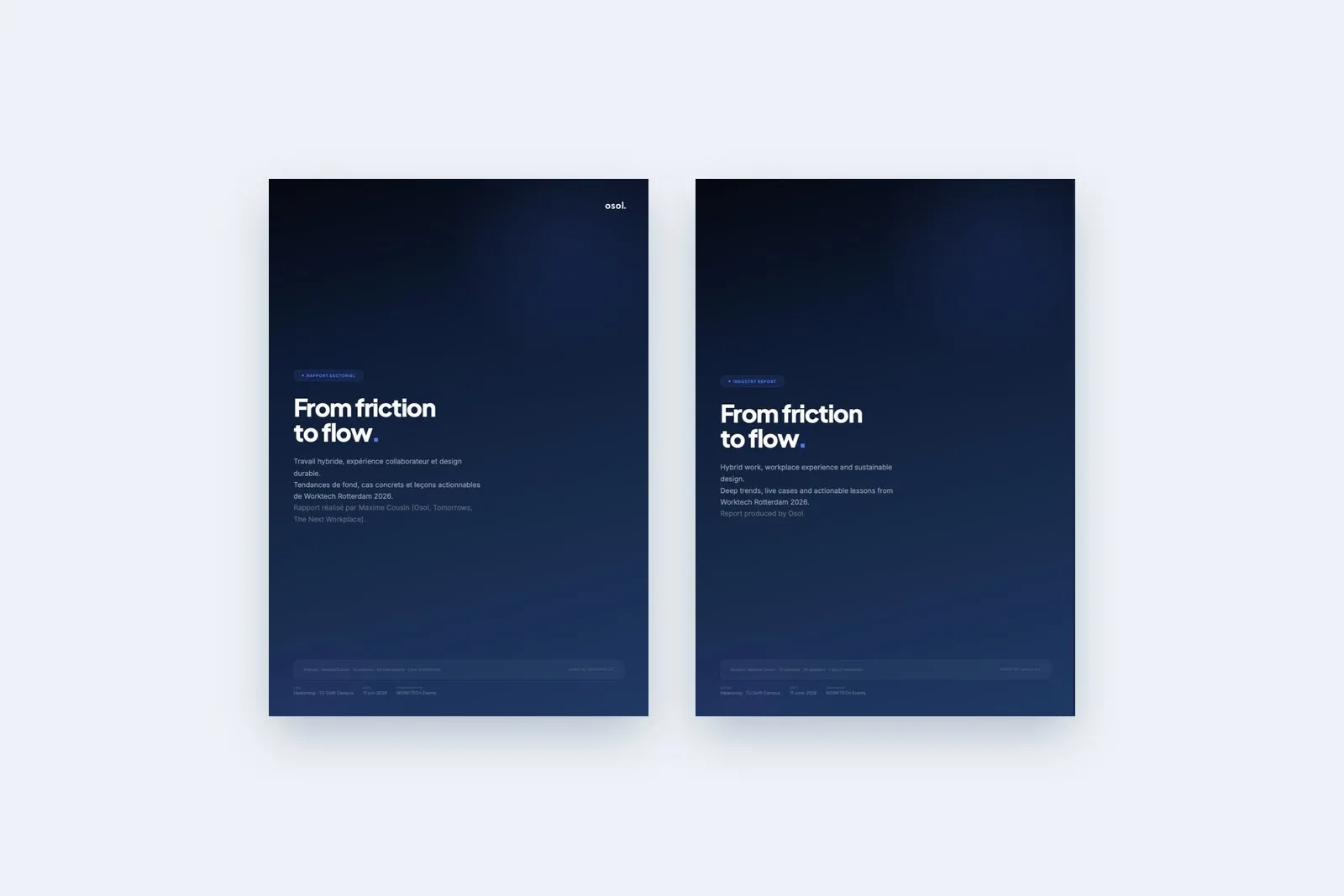
The venue was a case in point: a former Faculty of Mining turned into a gas-free office rated BREEAM-NL Outstanding. Here are the trends we drew from the day in our report, From Friction to Flow.
Designing for the average no longer works
Loes Visser, Managing Director of DataBuilt, opened the day with a simple observation: thermal comfort in our offices rests on research from the 1970s, carried out on male students in formal clothing. Since then, buildings have become excellent at holding 21 degrees, and occupants keep complaining.
Three people in the same room can feel cold, comfortable and warm at the same time. Her proposal: temperature profiles that change through the day, cooler in the morning, warmer after lunch. Comfort is the same or better, and a single degree makes a big difference to energy use.
The same logic applies to a portfolio. Kat Szoda, VP Global Real Estate and FM at Teva Pharmaceuticals, manages 300 assets in 26 countries with roughly 70% standard design and 30% local adaptation.
Attendance is earned, not mandated
Sabine Bink, Global Director Industry and Buildings at Haskoning, presented the building hosting the conference: 750 workstations for around 1,000 employees. A year after opening, attendance was back to pre-COVID levels, with no rules and no message from management. She put it this way:
People come to the office not because they have to, but because they miss it if they don't.
Mandates, meanwhile, run into Dutch employment law. Off stage, Booking.com's real estate leadership told us about its plan for two compulsory office days, blocked by the works council: 1,000 of its 7,000 employees never come in. For the panel, the sticking point is the line manager, who is poorly trained and not convinced.
Daaf Serné, founder of PlaceWorks Advisory, brought the most useful figure of the day: people come to the office when 3 to 5 close colleagues are there too. Below that, the desire to come in collapses. It echoes what we wrote about the return to the office: encourage rather than require.
A good hybrid meeting is 80% behaviour
Bianca Valkenburg, Lead Employee Experience at ING, presented the most complete case of the day: 811 meeting rooms in 8 buildings, for more than 20,000 employees in the Netherlands. Her rule: hybrid success is 80% behaviour, facilitation and shared norms, and 20% technology and space.
In an A/B test, teams coached on facilitation and tools rated their meetings one point higher out of 10 than teams in identical rooms. ING also learned to distrust averages: a score of 7.6 out of 10 was hiding an NPS of 31 for meeting rooms.
The equipment chosen is modest: two screens in large rooms, V-shaped tables, a camera that films the whiteboard. Digital whiteboards were dropped: most employees did not know how to use them.
Engagement is falling, and friction is the main cause
Claire Ward, Chief Innovation Officer at SPS, presented the State of the Workplace 2026 study, carried out with Worktech Academy among around 700 employees and executives in 8 countries. The share of highly engaged employees fell from 48% to 32% in a year. And those who disengage no longer leave: companies keep their headcount, not their energy.
The culprit is not strategy but an accumulation of small frictions. According to the study, which draws on Asana's Anatomy of Work index, 58% of the working day goes on coordination, searching and switching between tools. It takes 7 to 10 apps to get through a day at the office. 53% of employees would even consider leaving because of an inefficient workplace.
On the leadership side, 23% of executives have no workplace productivity indicator at all. Claire Ward's answer borrows from hospitality: anticipate needs so that people leave with more energy than they arrived with. She cited Zurich Insurance UK, where a single channel for reporting any friction led to around 1,500 problems being fixed, one by one.
Why sensors are not enough
Alejandra Jaimes Jimenez, Senior Project Manager Smart Buildings at Philips, told the story of the silent libraries. Sensors showed them almost empty, and the dashboard alone concluded they should become meeting rooms. The Leesman survey said the opposite: employees were asking for focus space. The problem was behaviour: people did not know how to use them. The answer was to explain, not to change the floor plan.
Raul Forsoni, Associate at UNStudio, added a rule about timing: data must arrive at the brief stage. Once everyone loves a design, the figures that contradict it get explained away.
Real estate is judged on experience, the city and reuse
Rick Sturkenboom, of a.s.r. real estate, explained that flexible floors and shared services help his buildings keep their long-lease tenants. Asked to vote, the room agreed unanimously that workplace experience is a responsibility shared by landlord and tenant. Few leases provide for it yet.
According to Jeroen Dirckx (KCAP) and Gábor Everraert (City of Rotterdam), only about 5 prime office locations remain in the Netherlands, all within 300 metres of a major station. Rutger Veldman, co-founder of Code Advisory, explained how Nike kept its EMEA headquarters of 4,000 people in Hilversum thanks to a plan for sports facilities open to the neighbourhood. In Amsterdam, Sjoerd Lycklama, partner at Flow Real Estate, lent the 25,000 m² of Tripolis, empty since completion, free of charge to startups and events: Uber and then De Brauw signed during construction.
Finally, reuse is entering public tenders. Paul van der Vlis, of the Rijksvastgoedbedrijf, requires every building delivered today to already meet the standards of 2050. In Maastricht, Hans Reineke, founder of Hollandse Nieuwe, is transforming 16,000 m² by reusing glass, steel and carpet, with batteries to cope with congestion on the Dutch power grid.
What we take away
Loes Visser's model assumes that people can change spaces as the day goes on. That only works if they can work anywhere, including far from an outlet, which partly explains why so many informal spaces stay empty. Power is one of those basics that should become invisible, like Wi-Fi or meeting room equipment, two pain points flagged by ING.
The report covers all 13 sessions and sets out concrete actions for each role. Download the full report
Frequently asked questions
When and where did Worktech Rotterdam 2026 take place?
On 11 June 2026, at Haskoning, on the TU Delft campus in the Netherlands. The organiser is Worktech Events.
What was the main conclusion of the day?
Organisations have invested in everything except the way work flows. Everyday friction has become the biggest drain on performance.
What is ING's 80/20 rule?
The quality of a hybrid meeting depends 80% on behaviour and shared norms, and 20% on technology and space. Coaching alone added one point out of 10.
How many colleagues does it take to make people want to come to the office?
According to Daaf Serné, of PlaceWorks Advisory, 3 to 5 close colleagues. Below that, motivation collapses.