Refurbished furniture: an ally of the flexible office
Office furniture lasts twenty years but is replaced far sooner. Why refurbished lets you refit without waste, with Maxime Baffert, founder of Bluedigo.
Refurbished furniture lets you reconfigure an office as often as its uses demand, without throwing away what still works. A piece of office furniture is designed to last twenty to thirty years, whereas offices change their look every five to seven years.
That was the observation shared by Maxime Baffert, CEO and founder of Bluedigo, on the NuWork podcast in early 2023: working ecosystem, legislation, availability and lead times, costs. Bluedigo stands out on three fronts: ecology, layout, remote work. The company collects used furniture from companies to restore and resell it, and complements its second-hand offer with a selection of new furniture from manufacturers that meet environmental criteria. All made in France.
Why does so much office furniture end up in the skip?
Because offices change faster than furniture wears out. Every year, 250,000 tonnes of office furniture are thrown away.
Maxime Baffert saw this first-hand. After twelve years at the same company, and a series of moves and reconfigurations experienced with it, he felt an urgent need to offer an alternative to this waste. That is how he founded Bluedigo, in July 2019.
Office activities produce 2.4 million tonnes of waste a year: 40% is burned, 40% goes to landfill, and only 15% is recycled. The creation of the producer responsibility organisation Valdelia reduced landfill and incineration in favour of recycling and reuse in the form of new materials. But according to Valdelia's figures, only 3.6% of furniture was made available to reuse and repurposing companies in 2021. This is a real missed opportunity: these raw materials consume a great deal of energy and emit CO2, in manufacturing, transport and incineration alike.
“Furniture is designed to last between 20 and 30 years. So it is made to have several lives.” Maxime Baffert
Yet when it is replaced every five years, furniture loses quality and availability. It does, however, have a rare advantage: it is not subject to technological obsolescence. It therefore lends itself particularly well to reuse.
Refurbished also answers the problem of lead times and costs
Before refurbished furniture became popular, companies had to put up with difficulties in sourcing raw materials and new furniture. Foreign suppliers weighed heavily in terms of both speed and price. During the pandemic, this model collapsed: supply lead times reached up to five weeks, a slowdown that fit-out projects could not afford. The shortage of raw materials (much of our quality wood being exported) added to the pressure.
Second-hand then became an emergency solution. It was in this context that Bluedigo accelerated its growth, having struggled to take off until then.
The price of new furniture was rising, and the increase looked set to last. Refurbished offered an answer to annual inflation, which reached 9.2% in March 2023 in the OECD area. The average price of a refurbished piece is between 20 and 50% below new. For Maxime Baffert, companies have enormous negotiating power at this level. Refurbished means:
- access to renowned brands, such as Herman Miller or Knoll, at 50% of the list price;
- fewer problems with costs and lead times;
- lower waste, transport and removal costs, by cutting down on intermediaries.
“A mismatched patchwork?” The most common concerns
Despite these arguments, refurbished was slow to catch on, particularly in the habits of public buyers. Reorganising spaces towards more flexible models raised several legitimate questions for companies.
- How can spaces be made more hybrid while supporting ecological initiatives?
- How can the workplace be renewed without offending employees' ecological conscience?
- How can flexible ways of working be kept distinct from impulsive changes?
- How can a consistent identity be maintained with refurbished furniture?
- Is there not a risk of ending up with mismatched furniture?
Will there be enough stock, and will it be consistent? This was the market's main limitation. Bluedigo strove to cover the whole chain and to broaden its catalogue. By handing over stock destined for the skip, companies themselves feed reuse: it is a virtuous circle, with new habits to form for suppliers and companies alike. In the meantime, Bluedigo maintained substantial stock made up of 75% new furniture, with a wide choice made in France, supplemented by 25% refurbished.
Will the quality be there? Sorting starts at take-back. Bluedigo only agreed to take back furniture on two conditions: a minimum of 50 workstations (desk, chair and pedestal), and only good-quality furniture. Out go IKEA furniture and the desk with a broken leg.
Will the identity of the spaces suffer? Not if you choose according to the space, rather than treating everything the same way.
New or refurbished: choose by space
For Maxime Baffert, the right answer is neither all new nor all refurbished. It is a mix, planned according to the space, availability and stock rotation.
- In productivity spaces, refurbished works very well: bench desks and office chairs are among the main pieces of refurbished furniture.
- In dining, social or creative spaces, design-led, signature, newly made furniture is preferable.
“75% of our sales are refurbished furniture, and 25% eco-designed new furniture.” Maxime Baffert
To achieve this, Bluedigo worked with some twenty partners in France, with a product list focused on quality and eco-design. Asked which word best summed up the future of office design, Maxime Baffert replied: “Hybridisation”. A word that, in his view, represents both the problem and the solution, and that applies to ways of working as much as to the furniture stock.
What about employees working from home?
Remote work also raises the question of equipment at home, and of including those who work remotely. To support companies that were making it a long-term arrangement, Bluedigo launched the Pass Remote in March 2021: a platform on which employees buy what they need to work well from home (ergonomic chairs, a second screen, monitor risers) with a voucher, and have it delivered directly. The basic pack cost €280 and included an ergonomic chair and a desk or bench. A way of reflecting the company's culture and values right down to the services offered to employees.
What the law says
The AGEC law (the anti-waste law for a circular economy) points in the same direction. In force since 9 March 2021, it requires public buyers to devote between 20 and 40% of their purchases to refurbished or reused products.
In 2023, however, the market was still at the evangelising stage. Companies refitting their offices kept their habit of buying new, and the way the law was applied still limited penalties. Maxime Baffert remained optimistic: it is by example that the latecomers would finally be convinced.
How does a take-back work, and how do you measure its impact?
In terms of cleaning, restoring a piece of furniture takes little energy. Bluedigo's process came down to four steps.
- The inventory, based on photos and information on the condition of the furniture.
- The meeting, to assess the take-back conditions on site when the stock is recoverable.
- The removal, coordinated as far in advance as possible: on-site photos, dismantling, on-site sale, care taken with the furniture.
- The CSR report, with a labelled take-back certificate.
Companies need to quantify the impact of their choices. With the help of an ecology consultancy, Bluedigo measured what refurbished represents in raw materials and carbon. The certificate given to the client stated the cubic metres of furniture saved, the CO2 avoided and the new stories created. Since its founding, Bluedigo has helped avoid the emission of 2,035 tonnes of CO2 and the consumption of 700 tonnes of polluting raw materials linked to manufacturing new items. Since 2020, the company has been a member of WWF France's “Entreprendre pour la planète” club.
Employees are pushing in this direction
Historically, eco-responsibility has been driven by employees and teams, and their influence should not be underestimated. A study by Cone Communications shows that one employee in two would not want to work for a company with no social or environmental initiatives. Now championed by executive committees, CSR concerns every department, and green furniture becomes part of what makes a company attractive.
The challenge remains to offer refurbished furniture in large quantities. It is the participation of companies that will allow this habit to spread.
“We need to dispel these fears about refurbished: learning, reassurance, communication.” Maxime Baffert
Refurbished is an alternative to new, with functional, high-quality equipment made to last. It is the end of obsolescence, which does not apply to furniture. And it is an effective way of supporting the local economy. Second-hand, material recycling, reuse, upcycling: for Maxime Baffert, refurbished will quickly become the benchmark for hybrid offices.
Three questions before refitting
- What should be kept?
- Which spaces can take refurbished furniture?
- How can you assert the identity of the place while saving resources?
Because the much sought-after “wow effect” can come precisely from mixing furniture.
People and companies mentioned in the conversation: Eurosite, Buronomic, Maxima Mobilier, Slean, Weburo.
What about the rest of the infrastructure?
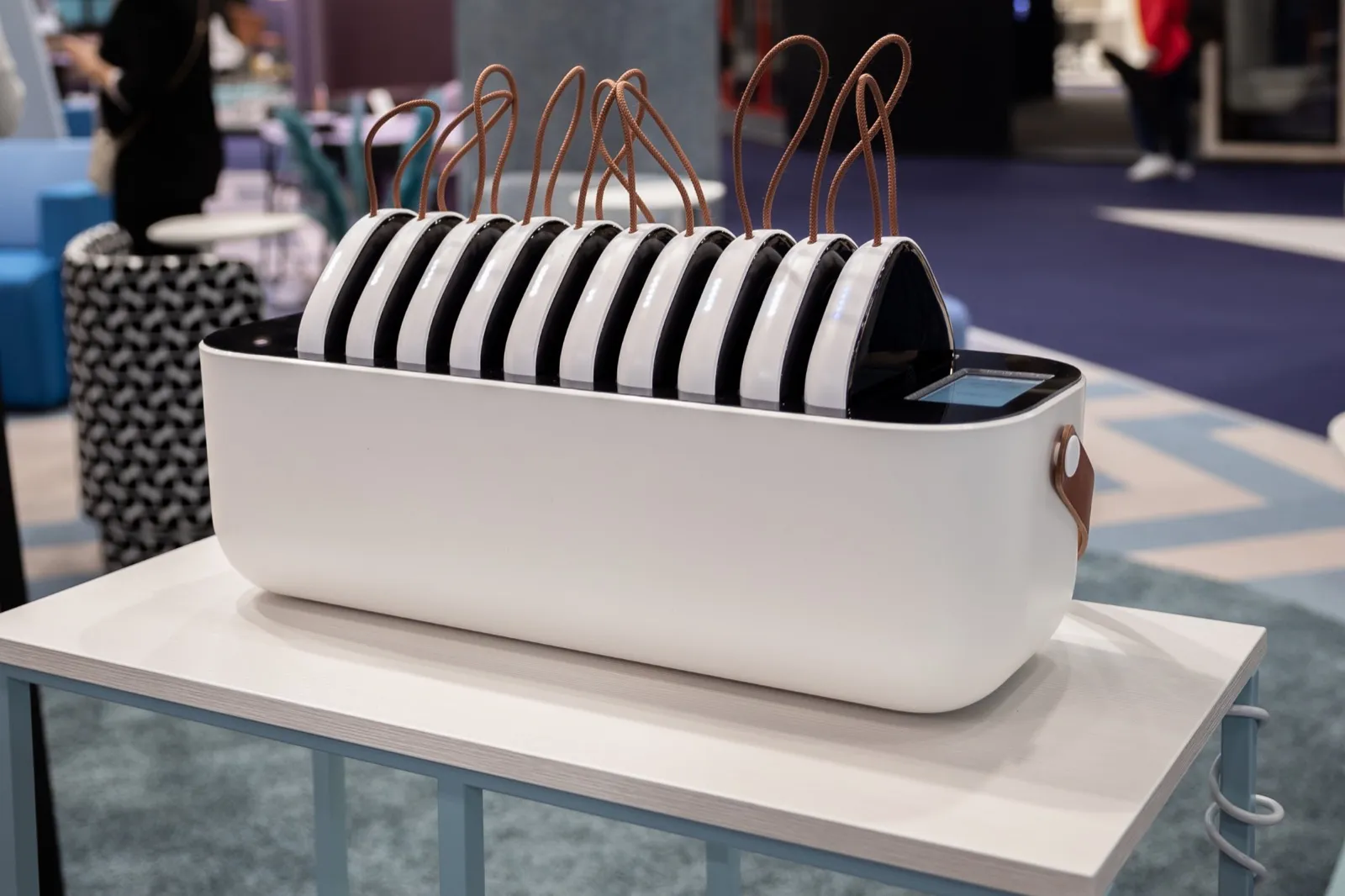
Furniture is not the only thing that holds back a refit. Outlets stay where the electrical plan put them, and moving a cluster of desks or creating a lounge often starts with construction work. Shared batteries, sitting on a station plugged into a standard outlet, make it possible to move spaces without touching the wiring. This is what we call power flexibility.
Frequently asked questions
What is refurbished office furniture?
It is furniture taken back from companies, restored and then resold. It extends the life of furniture designed to last twenty to thirty years.
Is refurbished furniture cheaper than new?
The average price of a refurbished piece is between 20 and 50% below new, and you can access brands such as Herman Miller or Knoll at 50% of the list price, with shorter lead times.
Which spaces are best suited to refurbished furniture?
Productivity spaces: bench desks and office chairs. For dining, social or creative spaces, design-led new furniture is preferable.
What does the AGEC law say about reusing furniture?
In force since 9 March 2021, it requires public buyers to devote between 20 and 40% of their purchases to refurbished or reused products.
How do you measure the impact of a refit with refurbished furniture?
A take-back certificate quantifies the cubic metres of furniture saved and the CO2 avoided, so it can be included in the company's CSR report.