Workspace Design Show London 2026: the office must earn the trip
In London, 11 talks converged: the generic office is over, and only an office that is designed, measured and prepared still earns the trip.
The Workspace Design Show London 2026 took place on 25 and 26 February at the Business Design Centre in Islington, London, under the theme "Connecting Realities". Over two days, more than 50 experts took the stage: architects, real estate directors, workplace leads, consultants, AI specialists. Their shared conclusion fits in one sentence: the generic office is over, and the office that remains has to earn everyone's attendance, which means starting with strategy, not with the floor plan.
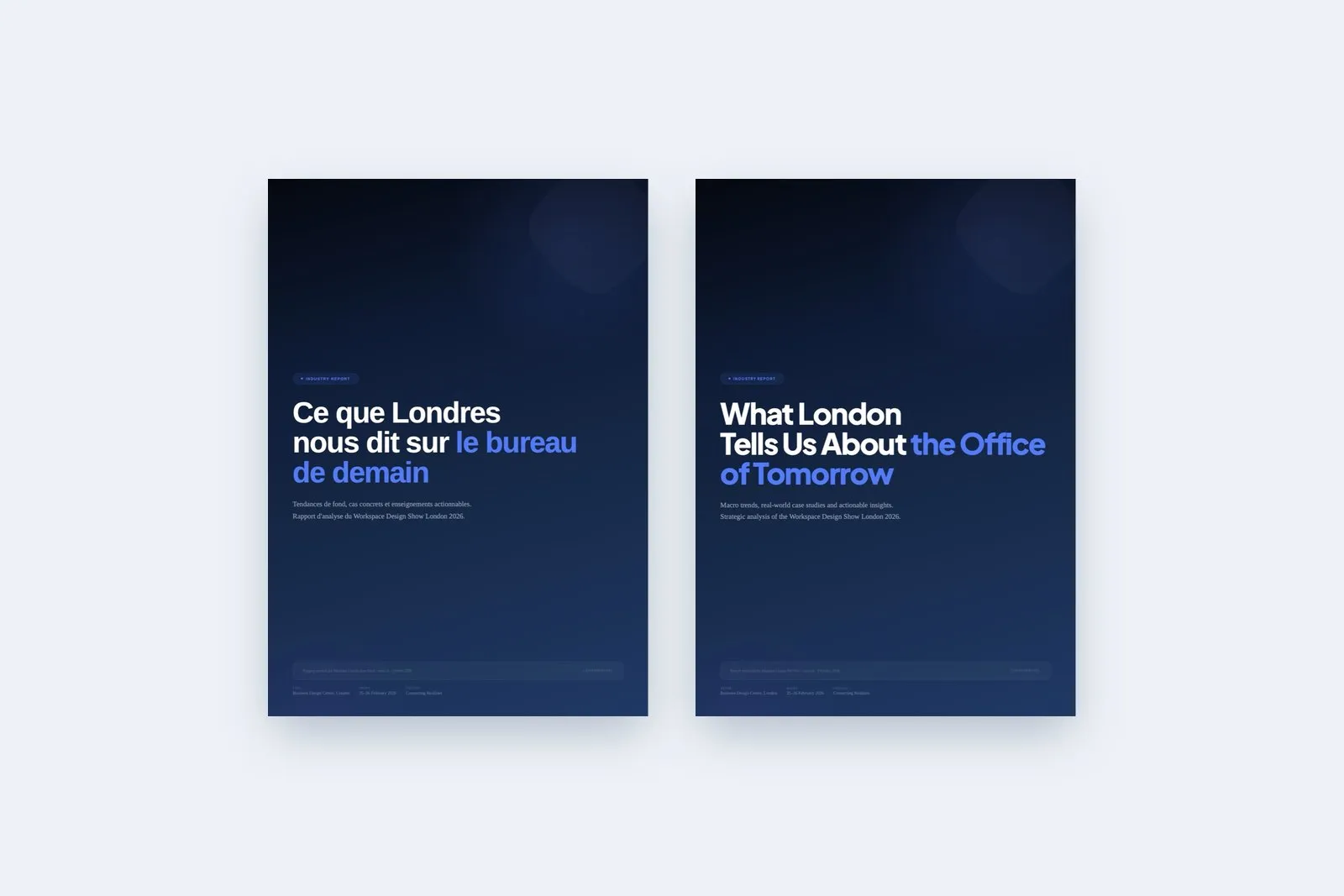
We followed 11 talks from start to finish. Our report, "What London tells us about the office of tomorrow", draws them together into 7 trends and 10 practical actions.
The generic office is dead, the intentional office takes over
Rows of identical desks, glass meeting rooms, a foosball table standing in for culture: nobody on stage defended that model any more. The office itself is not dead. It now has to earn each employee's visit, up against the home, the café and the coworking space. It keeps what remote work cannot offer: learning by watching others, difficult collaboration, a culture built together. EY, Amazon and others are renegotiating their leases for premium space.
Alisa Young, Design Director at Gensler, sees the desk coming back after years of replacing it with sofas. Paula Rowntree, from Imperial College London, says what employees actually ask for: "heat, light, desk, tech that works". Kasper Swartz, founder of Kasper Swartz Architects, asks why we accept office furniture we would never tolerate at home or in a hotel. He sums up the moment like this:
Something wonderful happened to the office, because we became super critical about it, and we tried to actually get rid of everything we don't like.
AI saves time, but it has no taste
On a show of hands, most of the room already uses AI every day or every week. At ServiceNow, automated ticket sorting saved 72,000 hours in a year, according to Lewis Barker. Adrian Norman, from Morgan Lovell, puts it simply: AI gets you a week down the line in 24 hours, and then the human design work begins.
The limits are precise. Hayley Samuels, from ServiceNow, cites an AI that estimated a need for 30,000 sq ft for a project in Germany. The real figure was 65,000: German standards require 2.5 to 2.9 metres between two back-to-back desks. Anna Burles, president-elect of the BIID, says it in one line: "AI doesn't have taste." Pavan Birdi, from HDR, draws a rule from it: use AI to narrow down the options, not to present five or six of them to the client.
Occupancy is no longer enough to measure an office
According to Adrian Norman, his clients average 30% occupancy across the week, with a Tuesday peak above 60% and troughs on Mondays and Fridays. Hence a simple piece of advice: plan for the peak, not the average. Octopus Energy is the exception, with 60 to 70% occupancy and Friday as its busiest day. But an occupied space is not necessarily a useful one: many collaborative spaces stay empty, while meeting rooms are taken by a single person.
So speakers are turning to more human indicators: sense of belonging, quality of interaction, the intention to stay with the company. Guzmán Blanco, from JLL Design, cites a project that moved to activity-based working: internal emails fell by 60%, because people talk to each other instead of writing. To win over the finance director, the strongest bridge is still the cost of an employee leaving.
Change and inclusion are decided before the first drawing
The firmest message of the show: change is prepared before the first sketch, not after the move. At Lloyds Banking Group, the transformation covers 12 buildings and 60,000 employees. Jennifer Bryan, a senior change management consultant with more than 25 years at Microsoft, Gartner, JLL, CBRE and Barclays, puts enablement ahead of control. For her, leaders who set the example and champions on the ground matter more than any communication plan. In her words:
It does not actually require control and compliance. It actually requires the enablement of others, to feel confident, safe, secure, and capable.
Sarah Grime, from The Gym Group, deliberately brought the critical voices into the project, not just the quieter ones. Her lesson: making no decision is worse than making the wrong one. The result was an engagement score of 9 out of 10 after the move. Several speakers back the same approach: deliver the essentials on day 1, then adjust on days 2 and 3. Paysafe froze the finishes during its rebrand for exactly that reason.
Inclusion follows the same logic. The session devoted to it presented a method of 28 to 30 user profiles, followed from waking up to going to bed. It warns against testing with volunteers only: the people who struggle most rarely put themselves forward. Gorka Lopez adds a "guardian of the brief", whose job is to protect these commitments from last-minute savings. Inclusion costs little when it is planned early: a USB-C cable that charges the laptop and connects it to the meeting room screen, a wall in the right colour, a space to find some calm. Sam Edmonds puts it plainly: "If you get it right, no one notices it."
Community is infrastructure, not a perk
The "Networks as Workplaces" panel gave the subject real weight. Helena Hughes, from Savills, points out that the risk of mortality is twice as high without community ties. Muriel Altunaga Aguirre, from The Flow, adds that chronic loneliness shortens life expectancy by around 15 years.
Small daily rituals build more trust than big programmes: offering a coffee, saying hello, agreeing that no question is stupid. Kirsty Shearer, from Agility Solutions, describes community in three circles: the team on the same floor, groups by job function and exchanges across countries. Free coffee and Friday pizza do not make a community. Sage, by contrast, plans its coffee strategy from day one: 13 offices opened in 18 months, guided by a document of 10 to 20 pages.
The building is becoming an operating system
According to Stuart Beety, the share of fit-out spent on technical intelligence (sensors, management systems, data) has doubled in 5 years and will double again. The real obstacle lies elsewhere: a company runs around 70 applications and 10 core systems that do not talk to each other. Privacy is another obstacle: AI in the building is moving faster than the rules. LinkedIn and Microsoft hold themselves to strict commitments on data. Ana Stanojevic, from Arcadis, also put a figure on the "corridor tax": 15,000 m² of corridors on a research campus, circulation space that creates no value.
What we take away
London describes an office that has to change quickly, in step with measured use. One layer is rarely mentioned on stage: power. When every reconfiguration means rewiring, the space freezes. That is why we talk about the last fixed infrastructure in the office.
The report also covers each of the 11 talks in a summary sheet, and sets out 10 actions sorted by role. Download the full report.
Frequently asked questions
When and where did the Workspace Design Show London 2026 take place?
On 25 and 26 February 2026, at the Business Design Centre in Islington, London, under the theme "Connecting Realities".
What was the main conclusion of the show?
The generic office is over. The office has to earn everyone's attendance, and that starts with strategy, before the floor plan.
What is the occupancy rate of hybrid offices in London?
According to Adrian Norman, from Morgan Lovell, his clients average 30% across the week, with a Tuesday peak above 60%.
What does the full report contain?
7 trends, a summary sheet for each of the 11 talks and 10 practical actions, sorted by role.