Looking back at Workspace Expo 2024
Osol's third Workspace Expo. Three talks: solidarity with Danone and Bureaux du Cœur, AI in real estate, employee experience at Ipsen, LVMH and Shiseido.
For the third year running, the Osol team went to Workspace Expo, the trade show dedicated to the Workplace, to present the latest version of the Osol Base. The team also attended three talks, summarised here: the workplace as a catalyst for corporate solidarity, AI for decision support, and the employee experience.
Workspace Expo needs no introduction. A trade show dedicated to the Workplace, it has brought together the biggest players in the field for several years, for 3 days of discussions and discoveries.
For the third year running, the Osol team went along to present the latest version of the Osol Base. It was also a chance to catch up with our partners, meet new players in the market and attend talks on the hottest topics in the Workplace.
Ideal real-life settings for the Picos
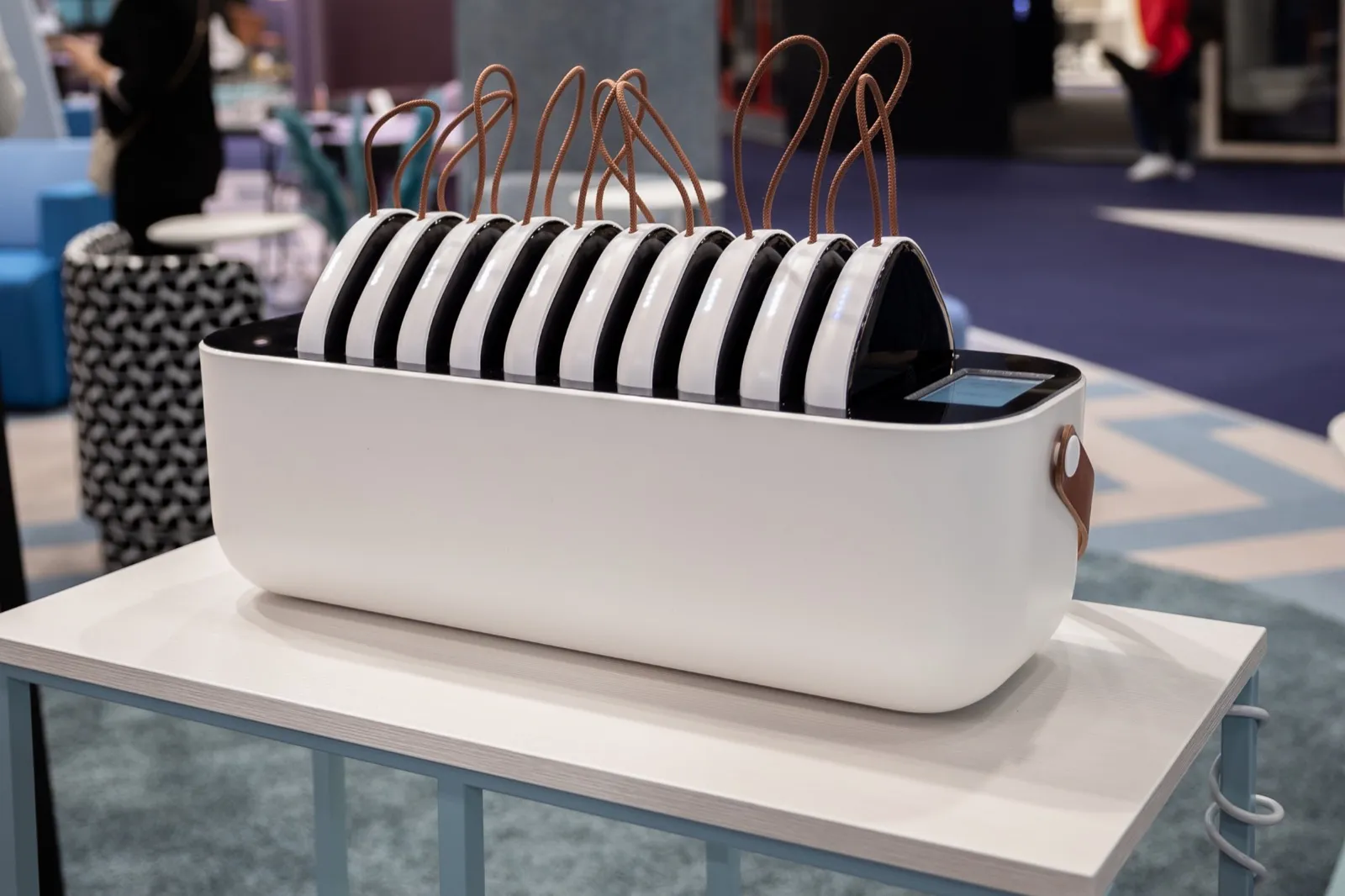
Workspace Expo is the perfect moment to present the Osol Base solution and its Picos. Visitors were able to discover its benefits and even use it on the different stands.
A flat battery on your laptop? On your smartphone? Or on your tablet? Osol was there.
Thank you to all our existing and newly met partners for your welcome.
Talks on every Workplace topic
Workspace Expo is also 3 days in which qualified speakers share their expertise in talks.
We attended a few of them, and here is a summary.
Talk 1: the workplace as a catalyst for corporate solidarity
How can a company create solidarity through its workplace?
Talk hosted by Sinem BEAUJEAN, Global Engagement Strategist @SEDUS, with the following speakers:
- Manuel MARTINS: Deputy Workplace Director France, DANONE
- Kinda GARMAN: Managing Director, BUREAUX DU CŒUR
- Marie-Hélène PORTEL: Senior IFM Operations Manager, CoreNet Global France Chapter, Vice-President, EMEA GLOBAL WORKPLACE SERVICES
- Valerie DEMARGERIE: President and Co-founder, LE CHAÎNON MANQUANT ANTI-GASPI
Non-profits that encourage corporate engagement
Starting from the observation that more than 330,000 people sleep on the streets in France while offices are occupied only 30% of the time, Bureaux du Cœur works with companies that offer their premises in the evenings and at weekends. Danone, the first listed company to adopt Société à Mission (mission-driven company) status, trusts Bureaux du Cœur and offers its spaces to house people in need. Company premises provide a safe, stable setting that makes cooperation and activating networks easier. Beyond the accommodation itself, informal contact with companies speeds up the beneficiaries' social integration.
Le Chaînon Manquant, for its part, specialises in food redistribution. It plays a crucial role in the fight against food waste and poverty in France. Every day, the initiative collects good-quality surplus food from partner organisations (companies, schools, hotels, etc.) and distributes it immediately to local charities that take in people in need. Faced with an alarming reality in which 10 million tonnes of food are lost every year and 8 million people go hungry, the initiative has mobilised more than 300 committed volunteers since 2014. Its commitment to a responsible, caring world translates into concrete action to meet the essential needs of the most deprived.
Solidarity initiatives to encourage employees
As employees place more and more emphasis on the search for meaning and deep values, companies' commitment to social and environmental responsibility is no longer just a concept. Some candidates even assess it during job interviews, as Thierry Allio (Shiseido) noted during a talk organised by IDET (the third talk summarised below).
Encouraging employees to get more involved in these issues is therefore becoming a crucial new challenge for Workplace and Human Resources departments. One of Danone's ideas is to create “employee engagement programmes” that allow anyone who wishes to work for a charity for a day. Companies that connect employees with charities have also emerged in recent years.
Key takeaway: create connections
That was the final word of the talk: connection. Every individual can help in some way, and companies must now encourage this kind of initiative.
Talk 2: AI for decision support, the future of your workspaces
How can offices be laid out with the help of AI?
Talk hosted by Sébastien ROCQ, collective intelligence and new ways of working, and journalist @OFFICE ET CULTURE, with the following speakers:
- Cyril HADJI-THOMAS: CEO & Cofounder @WAITACK
- Blaise HEURTEUX: Founding Partner of HBS-research @LA PLACE DE L'IMMOBILIER
Tools to make daily life easier for real estate and Workplace teams
Artificial intelligence has been part of our working lives for a few years now. But it is still little used and remains an unfamiliar tool for most of us, even though it can be a major ally in the work of a head of real estate or a Workplace director, for example.
To explain artificial intelligence clearly, the speakers started from a scale of AI's different objectives:
- Automate: basic, long-established AI (autofocus, anti-spam…)
- Imitate (speak, listen, see, understand): still the main objective pursued by well-known AIs such as ChatGPT, which rely on data available on the internet
- Optimise (logistics, traffic, etc.): less data, but better qualified
- Design and predict (weather, security, environment…): extreme complexity, something even a human has never managed to do alone
As real estate becomes increasingly digital, using data is more than necessary. That is how La Place de l'Immobilier came about, with the aim of offering all building data on a single platform.
But the challenge is not only collecting data: it is also using it to create value. For office layout, Waitack instantly runs every possible real estate scenario so that an optimal, shared decision can be made.
Tips for the daily work of real estate and Workplace teams
Implementing solutions such as La Place de l'Immobilier and Waitack can be a great help in decision-making. But there are also tips that can make the daily work of these roles easier. For example, some AIs can automate the reading of leases or other PDF documents to extract and classify their content. It saves a considerable amount of time, which can then go into other tasks that AI can do little or nothing to help with.
According to the speakers, the true role of real estate is to work on using data to create indicators that nobody can produce alone. Because real estate and the workplace are central fields, they will always be linked to another function (HR, IT, Marketing or Sales), so the key is to extract practical, qualified information to prepare decisions.
Talk 3: employee experience, or how to build journeys that foster team engagement and well-being
Speakers at the talk:
- Alexis TORGOMAN: Facilities & Ehs Manager @IPSEN
- Franck DOUAU: General Secretary @IDET and Deputy Facilities Director @LVMH
- Thierry ALLIO: Management committee member @IDET and Workplace & Environment Service Manager @SHISEIDO
The basics of employee experience
The talk opened with each speaker giving a brief view on employee experience. For Alexis, “taking good care of employees is a given”, all the more so as this experience is becoming far more important than traditional benefits such as salary. According to Thierry, you need to know how to attract and retain talent, and that means providing relevant services. Finally, Franck stressed the importance of working on the employee experience to make the much-discussed return to the office a success.
The parallel between employee experience and customer experience was also raised in the introduction, highlighting that the two cannot be separated.
With 27% of employees saying they feel fulfilled at work, it is even clearer why this concept is discussed so much, and why solutions are needed to improve it.
To put this into perspective, the speakers reworked the famous Maslow's pyramid into a pyramid specific to the Workplace. Starting from basic needs (number 1), they defined the other types of needs to understand where, when and how to act in response to employees' requests and operational realities:
- Physiological needs: workstation ergonomics, toilets, water fountains, catering, fresh air, air conditioning, etc.
- Safety needs: simple, smooth access, cleanliness, working equipment, evacuation capacity
- Social or belonging needs: shared spaces, convivial places, staff restaurant, etc.
- Esteem or recognition needs: personalised service, recognition
- Need for self-actualisation: self-fulfilment
This original approach highlighted the types of needs and their importance. Each speaker then shared lessons from their own organisation on employee experience.
Lessons from IPSEN, LVMH and Shiseido
The pyramid presented is a good basis for reworking your employee experience, but you have to bear in mind that well-being varies. If one element of the pyramid breaks, everything collapses. It is therefore essential that Workplace teams stay adaptable, because mistakes are inevitable: a new service cannot always be a success.
Adaptability was therefore described as “the key” to a good employee experience. And to adapt, you have to listen: feedback is one of the key elements the speakers highlighted. Examples of feedback initiatives put in place:
- Questionnaire with closed and open questions
- Welcome breakfast: presenting the services and inviting people to give their opinion
- Facility Management centre: an office where employees come to make their requests
- Floor stewards: employees who go round the offices to take the temperature, handle maintenance requests, etc.
Beyond collecting feedback, the most important thing is to take action to create value from it. Employees need to see that their requests are taken into account (an email or follow-up message on the request, an invitation to take part in a workshop, etc.).
Final words
Although the three speakers work in different organisations, they agree on several points about employee experience. Here are the last takeaways from the talk:
- Give meaning to what you do (Alexis Torgoman)
- 5 years ago, well-being was not a topic, but we are now at a turning point, which makes Workplace roles more and more central to the company (Thierry Allio)
- People remain the foundation (Franck Douau)
Ready for the next edition?
Once again, Workspace Expo brought together everyone involved in and passionate about the Workplace to meet, exchange ideas and discover the exhibitors' latest products.
The Osol team is already looking forward to coming back next year.
Frequently asked questions
What is Workspace Expo?
A trade show dedicated to the Workplace, which has brought together the biggest players in the field for several years, for 3 days of discussions, discoveries and talks.
How does Bureaux du Cœur use company premises?
It works with companies that offer their premises in the evenings and at weekends to house people in need, starting from the observation that offices are occupied only 30% of the time. Danone is one of these companies.
What is the key to a good employee experience, according to the speakers from Ipsen, LVMH and Shiseido?
Adaptability, which starts with listening: collecting feedback, then taking action and showing employees that their requests are taken into account.