Managing the work environment in the hybrid era
With hybrid working, the office is not used the same way every day. MerciYanis CEO Guillaume Blanc on how data and usage-based cleaning change the job.
Managing a hybrid work environment means moving from a service that is identical every day to a service adjusted to actual use: you measure occupancy, satisfaction and consumption, then step in at the right place, at the right time. That is the conviction Guillaume Blanc, CEO and co-founder of MerciYanis, set out in 2023 on the 10th episode of the NuWork podcast, produced in partnership with IDET, in conversation with Maxime Cousin of Osol.
Key points from the episode
- The office remains essential: it is where relationships, trust and innovation are created, even with the rise of third places.
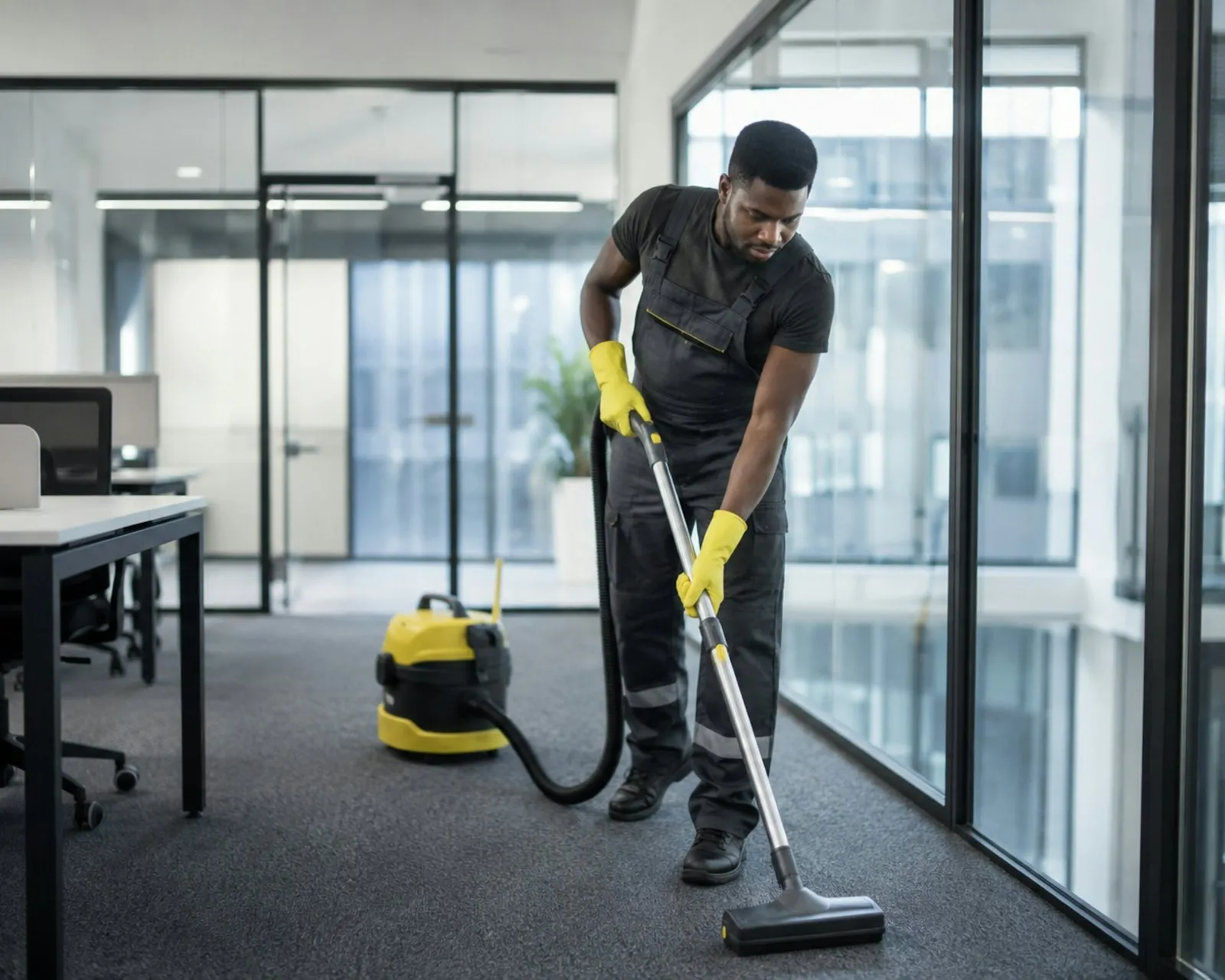
- Usage-based cleaning means carrying out the right intervention at the right place, at the right time, based on occupancy, satisfaction, consumables and even the weather.
- Data has its limits: extending the service to employees' homes raises the question of intrusion into their private lives.
- The role of workplace director is becoming cross-functional: they work with IT, service providers and employees, and data becomes their main decision-making tool.
- Restraint and comfort have to be reconciled: reducing heated floor space, for example, frees up budget to improve the rest of the building.
What follows is the transcript of the episode, cleaned of the repetitions of spoken conversation. The episode is part of a series on hybrid working, which aims to understand how hybrid working, the work environment and ways of working are changing.
A profession that has become more complex
The work environment has become a complex subject, because it now has to bring together social, digital and technical factors. The remit of the workplace department (DET) has changed, giving it a more central role in how companies develop, halfway between people and technology.
This new framework requires the profession to offer an almost perfect experience, to anticipate incidents and to adapt to different contexts. Workplace professionals are discovering, or rediscovering, a need to work with other trades. They all share the same goal: offering the best possible service to employees.
In a context of rapid change, the office remains essential for building relationships, and it matters to company performance. The new tools available to workplace departments let them manage it more economically, more efficiently and more sustainably.
How are workplace professionals reinventing their job in the face of new demands for adaptable, flexible spaces? Hybrid working creates new roles, but it also brings new challenges. With variable use of space and needs that keep changing, MerciYanis, software designed to help workplace departments in their work, helps them see the project as a whole. It approaches the subject from the angle of usage-based cleaning, a way of optimising how resources and the environment are managed.
Meet Guillaume Blanc, CEO of MerciYanis
Maxime Cousin: Welcome to a new episode of the NuWork podcast, an initiative launched by Osol and IDET, the association that brings together everyone in the workplace sector. Today we're joined by someone hyperactive: Guillaume, thank you for joining us. You wear two hats: the IDET hat, as a very active member, and the service provider hat, in contact with everyone in the workplace sector. You approach hybrid working from a different angle from a workplace director or a facility manager. Could you introduce yourself?
Guillaume Blanc: I'm CEO and one of the co-founders of MerciYanis. I have a very technical background, as I studied computer engineering, and I knew nothing at all about the world of the work environment. At the end of our studies, Élise and I decided to start a business. We met Yanis, who at the time was head of facilities at IoT Valley. Talking to him, we discovered his profession and had the idea of developing software and a whole range of sensors to help him in his work.
The work environment, a profession reinvented
Maxime Cousin: When you come from an engineering background, it's hard to grasp how complex the work environment is. It involves a huge number of players. How did you go about learning it?
Guillaume Blanc: Yanis helped us a lot, we spent hours talking. We realised how much value these professions bring. In 2019, for three or four months, I contacted many heads of facilities on LinkedIn (today we would say workplace directors) to understand their day-to-day work, their needs and their relationships with their teams. That's how I gradually understood how the profession fits together.
Maxime Cousin: For my part, it was thanks to IDET, especially Latifa Hakkou, but also to people at JLL such as Flore Prader, that I began to see how complex these issues are. Halfway between people, technology and IT, everything comes together to create a new experience. Even more so today, with the shift to hybrid working. How did you see that shift, on a large scale?
Guillaume Blanc: It inevitably affected the whole profession. We're quite close to operations, and overnight new ways of working appeared, with an immediate need to adapt. The Covid crisis and everything that followed brought the whole ecosystem years of digitalisation.
Connection, a factor of success
Maxime Cousin: Talking to many workplace directors, but also to employees and HR directors, I can see that the vision of the office of tomorrow has changed enormously. If you had to sum it up in one word?
Guillaume Blanc: I'd say “indispensable”. I really believe in the hybrid model, with the emergence of third places. But I remain convinced that a company, to work in the long term, has to let its employees see each other, be in the same room. Innovation, relationships, trust: all of that can only be created with your colleagues. For me, that's what will separate the companies that perform from those that struggle to retain their talent.
What form will the office of tomorrow take?
Maxime Cousin: The office has to be there, even if it takes different forms. For some, it's a coworking space, because that's where people meet. But having a physical space remains a matter of culture, attractiveness and collaboration. With a team that's starting to grow, you're well placed to feel the energy that builds when everyone is together, compared with when nobody sees each other. Are the companies you work with asking whether they should keep their offices, and how to evolve them?
Guillaume Blanc: We work with mid-sized and large companies, so keeping offices isn't in question. Some start-ups work 100% remotely, but for a mid-sized company that's not possible. On the other hand, you can ask: what form should these offices take? How should they be sized? And what alternatives should be offered? Third places are one of them, and we also work with coworking spaces. For example, one of our biggest clients is WeWork: we've equipped its 19 buildings in Paris.
That said, in an area where we don't sell yet, there's a real question for workplace departments: how far should they go in supporting employees? Is it up to the company to meet their comfort needs when they work from home? At the office, the answer is obvious. At home, it isn't.
How far should the service extend when employees work from home?
Maxime Cousin: It's a fascinating subject. At Osol, we start from the principle that employees have access to power when they're in the office. They charge their laptop at the office without adding to their personal consumption. “I'm doing my work at home. Can I get the same continuity of service there?” In the last episode, Latifa Hakkou, workplace director at Ipsen, explained that for her this was the number one issue. Now that the office has broken up into countless places, how do you extend this service to employees working remotely?
Guillaume Blanc: There's a whole question of interference. Where does this continuity end? In a company, we often measure temperature, humidity and CO₂ levels. Some clients have considered doing so in employees' homes. But nobody wants to feel their privacy is being invaded: “I don't want my company to know what temperature I heat my home to, or what my humidity or CO₂ levels are.” You have to ask where to stop, and the limit won't be the same for every element.
Maxime Cousin: How do you organise these discussions? Is it almost a matter of internal lobbying, to set the rules of the game? How do employees and companies agree on a common rule?
Guillaume Blanc: We're transparent and we work hand in hand with workplace departments. We advise them, we prepare the meeting together, and then they're the ones who lead the project internally.
Maxime Cousin: Data is key at that point, but it can be seen as an intrusion into employees' lives. That can hold back the harmonisation companies need.
What is usage-based cleaning?
Maxime Cousin: You mentioned “usage-based cleaning”. Can you define the term? How has the concept developed with hybrid working, and what does it change in terms of productivity, costs, cleaning, quality of service and CSR?
Guillaume Blanc: It's fairly new. It appeared after Covid, with the introduction of hybrid working. The definition we often use is: carrying out the right intervention at the right place, at the right time. The office is no longer occupied in the same way, so you need to use data to add more value to the service, and only step in when it's necessary.
The data that guides interventions
Guillaume Blanc: For usage-based cleaning, we have several sources of information. The most obvious is the occupancy rate. If a meeting room hasn't been used all day, why clean it? It can wait until the next day.
The second is satisfaction. By continuously taking the pulse of spaces, in the toilets for example, you can see that dissatisfaction signals a need for cleaning, even if there has been little footfall.
Finally, you can connect to consumable dispensers: soap, paper and so on. Combined with footfall counts, you can statistically anticipate shortages and spot cases of overconsumption.
Maxime Cousin: On the one hand, you use this data to make daily operations more efficient. On the other, you can anticipate future needs, including financial ones. You get a snapshot of how resources are used in the building.
Guillaume Blanc: People often talk about building data, but usage-based cleaning can also rely on external data, such as the weather. If it rains, spaces will be dirtier, and you already know you'll need more time and more staff. You take into account factors beyond what's happening inside the company.
A social responsibility and a human issue
Maxime Cousin: All of this combined lets you act on the financial side, and even on CSR. If one day a company cleans only 40% of its site when it used to clean 100%, it can easily cut its spending. How can this model be replicated? Can these benefits support the case a workplace director has to make to an executive committee?
Guillaume Blanc: I don't think the market is mature enough yet to announce a clear return on investment. It depends a lot on each company and its actual occupancy, and we don't yet have enough hindsight: I encourage our clients not to take risks on this point. On the other hand, I stress another benefit: the cleaning company can deliver a consistent quality of service, always in line with the criteria agreed with the client.
On the CSR side, you avoid needlessly consuming cleaning products and water, and you improve working conditions for cleaning staff, for example with daytime cleaning. It's a model I strongly believe in: a cleaner on site all day. With usage-based cleaning, you can guide them day to day and train them for tasks beyond their original remit. According to a figure I'd seen the previous year, 90% of companies that have switched to daytime cleaning don't want to go back.
The other advantage is that it creates a connection between employees and the cleaning company. I see it in our offices: I enjoy talking to the cleaner, we build a relationship, and it makes me more responsible as a user of the building. I know who looks after the cleaning, so I'm more careful.
A virtuous circle of collaboration
Maxime Cousin: The cleaner can also see their effectiveness first-hand, and enjoy contact with employees. So the cleaning company, the provider and the client form a trio?
Guillaume Blanc: That's exactly it. We sign either with the cleaning company or with the end client. But the idea we want to promote is to stop thinking in silos. We want to bring everyone in the work environment together on a single platform, and beyond the tool, get them working as a team to give employees as perfect an experience as possible. For them to make the effort to come to the office, they need an excellent quality of service.
Towards a healthy work environment
Maxime Cousin: People were long forgotten in thinking about the work environment, even though they are essential players. Bringing people back to the office is hard when the company is competing with home. You have to recreate good conditions: when they come in, they must find what they're looking for, colleagues and a healthy environment.
Until now, facilities teams had a mostly technical role. By becoming the work environment function, these professions have grown more complex, between technology and people. Before, it was hard to bring IT and facilities together on the same project. Have you seen those divides among your clients?
Guillaume Blanc: I feel it too, and I really appreciate working hand in hand with IT. We now share the same desire to offer employees the best service, whereas at the start their interests were opposed. The profession had to go digital, when it had been barely digital before. It also had to learn to “manage uncertainty” in the hybrid model: offering a controlled service throughout the day, while being able to respond to exceptional cases that are impossible to anticipate.
The new role of the workplace director
Maxime Cousin: Has this change also altered the qualities and skills expected of tomorrow's workplace director?
Guillaume Blanc: Yes, there's a whole social side to the job. Workplace directors need a much more cross-functional view of the company: they no longer stop at square metres. I think people like that, given how central the role has become to the employer brand and to talent retention.
The tools are changing too. At first, they served internal organisation and productivity. Now they also cover services for employees and how to work with partners. Workplace directors are moving from a service-provider role to a more involved one, where they think about the whole. And they are realising that data is the key to anticipating needs and making the right decisions. They need a strategy.
Maxime Cousin: Knowing which services are most in demand, which are less so, which are used at what time and in which place: that information is valuable for workplace directors today.
Restraint, an employee expectation and a question of cost
Maxime Cousin: You mentioned CSR. From your outside perspective, what place does it have in companies? Is it as crucial as it seems? Are there already solutions in place, technical or otherwise?
Guillaume Blanc: The new generation needs to identify with the company. If an employee has environmental convictions, they want their company to respect them too, and the workplace department has a real role to play. If nothing is done on energy restraint, it can cause problems with some employees.
The other, more pragmatic issue is cost. With rising energy bills, it's becoming essential to act to optimise this item of expenditure.
Maxime Cousin: To make the office attractive, you need actions that engage employees, and CSR is one of them. You need a quality environment: clean, with the right types of space, the right technology, brought to life by the right services, with a hospitality offer. All of that costs more than before. Paradoxically, optimising budgets becomes vital, whereas before we heated the whole building without a second thought. Mindsets are shifting: shouldn't we make better use of our resources to create a better-suited experience?
An environment that takes everyone into account
Guillaume Blanc: That's exactly it. You have to involve employees, but where do you set the dial to satisfy the majority? If I stick to the recommended 19 degrees, some employees will be cold and won't be working in good conditions. That's not easy when they have the choice of staying at home.
Maxime Cousin: A colleague on our team, who is very committed to CSR, is cold at 20 or 21 degrees, whereas I would be too hot. Until now, we've had a uniform, one-size-fits-all model. We're moving towards a model where everyone's individuality has its place, with settings that vary by department or by person. The diversity of profiles will be better recognised. How do you see this attention to individuals evolving?
Guillaume Blanc: That's where data really matters: you need to be able to track what's happening. With hybrid working, some companies realised that part of their premises wasn't being used. They grouped employees together and closed an entire floor, which they no longer have to heat. They save energy, and it frees up budget to improve other parts of the building. Once again, there's real work to be done hand in hand between workplace directors, the facility managers who run these matters, and employees.
Frequently asked questions
What is usage-based cleaning?
It means carrying out the right cleaning intervention at the right place, at the right time, based on data such as space occupancy, user satisfaction, use of consumables or the weather.
Why does hybrid working change how offices are managed?
Because the office is no longer occupied in the same way every day. An identical service everywhere and all the time becomes unnecessary in some places and insufficient in others.
What is the new role of the workplace director?
It is becoming cross-functional: they work with IT, human resources and service providers, and rely on data to anticipate needs and make decisions.
Does the office still make sense with remote work?
Yes. For Guillaume Blanc, it remains essential, because it is where relationships, trust and innovation are created between colleagues.
Can employee comfort be measured when people work from home?
It is technically possible, but it raises the question of intrusion into private life. The limit has to be discussed with employees, element by element.